Category: Uncategorized

  • Camping Theology and the Great Disconnect.

    Camping Theology and the Great Disconnect.

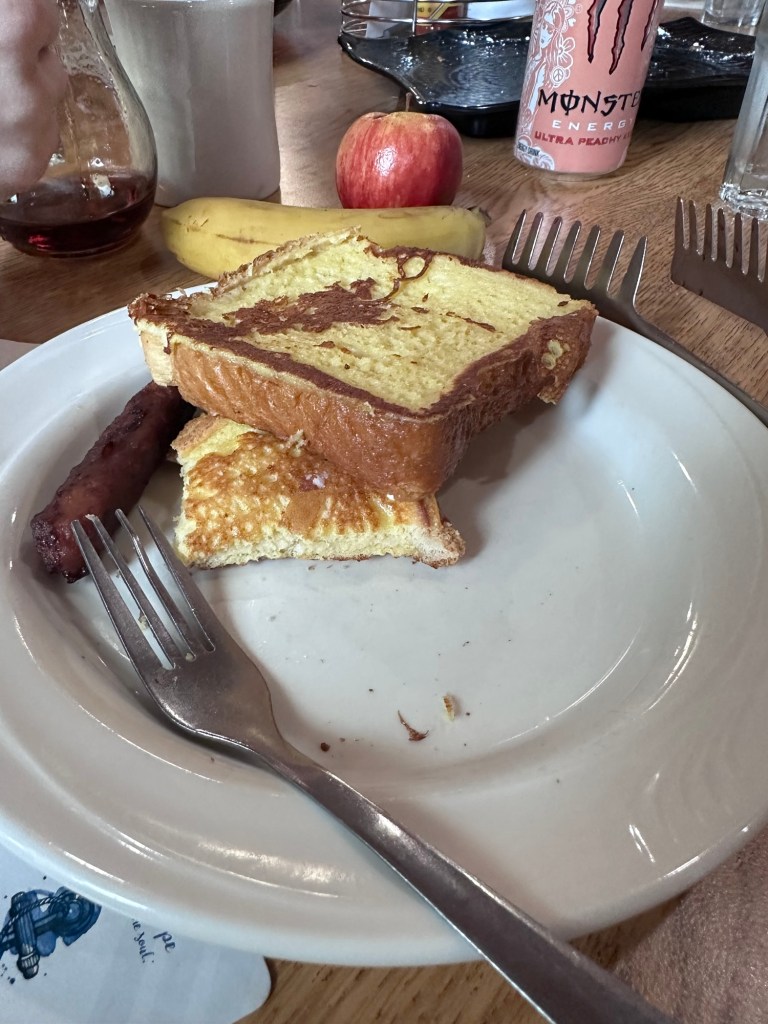
    A hearty breakfast before worship (God bless it).

    What is it about trees, open land, a pile of pancakes, a dining hall with a modern, cabin-esc vibe, basketball courts and highly weathered balls, not to forget, the ever-humbling Pickleball court that turns even the proud into the breathless… that makes it all feel so magical?

    No, this isn’t just any campsite. This is church camp.

    And yes—I’m 39 years old. I know. Church camp isn’t just for teens with underdeveloped frontal lobes. It’s for grown adults with student loans, aging knees, and deep questions about meaning, suffering, and why camp mattresses are still apparently made from recycled plastic cups.

    No. My foot was not over the line. (Photo Credit: Bre Gray- bregrayphotography.pixieset.com)

    At first glance, it’s a recipe you wouldn’t expect to nourish the soul: communal sleeping with nine other guys, unreasonably early mornings, and food so rich and hearty it feels like we’re dining with medieval royalty (minus the beheadings, plus a lot more cheese). And yet, somewhere between the 16-hour days, the constant change of sweaty clothes, and the silverware I didn’t have to wash, I remembered something.

    Every day had rhythm at camp: morning and evening worship services, time carved out for silence and scripture, group discussions about faith—where it’s lived, where it’s lost, and where we’re still fumbling in the dark. But it’s not just the programming. It’s what happens when we step outside the script of “real life” and into something slow, and never ending.

    At 39…my back starts to feel it.

    Be honest: our daily lives are designed to distract us from ourselves. We march through schedules, crush goals, pay off student loans (until the end of time), scroll endlessly, and quietly wonder, “Is this it?”

    But camp—the right kind of camp—brings you face to face with your own soul. You can’t outrun it out there. There’s nowhere to hide when you’re sitting around a well-crafted cabin table, under a star-pierced sky, holding a thermos of Minnesota’s finest tap, and realizing how long it’s been since you actually felt still.

    One of the biggest things I see as a therapist?

    People are disconnected from themselves.

    Not the version they present to the world. Not the curated personality or the productive employee or the “good” parent. I mean the real them. The one that’s still under there somewhere, buried beneath bills and burdens and the belief that if we just push hard enough, we’ll eventually feel okay.

    But here’s the catch:

    We don’t know why we do what we do.

    We think we know. We tell ourselves stories.

    But often, those stories aren’t true.

    That’s why reflection—real, sometimes uncomfortable reflection—is so important. Because if we don’t pause and reassess, we wake up one day bitter, cynical, and convinced that the best parts of life are behind us.

    Being with middle school through high school students this past week reminded me what it was like to be joyous and live in the moment. They had within them a camaraderie that we often don’t find in the routines of everyday life. These students had each other and they had, well, connection.

    Connection, especially the kind that touches the deepest part of our being, is what we were made for. Not just connection with people (though that’s crucial). But connection with God—the Creator who sees through all our layers and still longs to be close.

    And when we don’t connect with Him?

    We find substitute relationships:

    – With our careers

    – With approval

    – With achievement

    – With control

    But those things will fail us, sooner or later.

    They make terrible gods and even worse friends.

    Yet life isn’t shallow. Not at all. It’s deep and eternally significant. Every moment. Every choice. Every quiet ache.

    The tragedy is not that life lacks meaning, but that we rarely stop long enough to see how meaningful it actually is.

    And no, you don’t have to be at a camp with creaky bunks and bug spray in your hair to realign. You can pause for five minutes between Zoom calls, or in the carpool line, or right before you open another Microsoft Word doc, and simply ask:

    “What’s really going on in me right now?”

    “What do I want to be about today?”

    “God, are You near—and am I listening?”

    If you do that daily—even just for a week—you might be surprised. You might start to see your life with fresh eyes. You might remember that you are more than your resume, your obligations, or your debt-to-income ratio.

    Because here’s the truth:

    You can’t have a great marriage without effort.

    You can’t be a great athlete without training.

    And you can’t cultivate a soul without intentional time with the One who gave it to you.

    From where I stand, the greatest lack in most people’s lives is not time, not opportunity, not intelligence, or even love.

    It’s spiritual disconnection.

    From God. From truth. From themselves.

    But the good news?

    You can reconnect.

    Right now.

    No reservation needed.

    And maybe—just maybe—that’s where the real magic begins.
  • To be honest…

    Honestly? I sat down to write this with zero agenda. Nothing. My genius said, “Just start writing and see what happens.” Always a solid strategy.

    So here I am—two lines deep—and already staring at the blinking cursor like it’s judging me.

    Idea one: What happens when the worst thing in life happens?

    Nope. Too heavy. Not today.

    Okay okay, here’s one: What happens…

    Gross. That’s so vague it could be a free online article…oh.

    Wait—I’ve got it:

    I have absolutely no idea. That’s the idea.

    Yep. No one knows the answer. Not me, not you, not that podcast host with the perfect bookshelf background (which I have-less perfect however). Not your favorite fitness influencer, your mom Facebook group, your stylist, or that one guy at the gym who somehow always has advice for everything except leg day (and diet).

    Forgive my little neurodivergent detour here, but when we’re trying to solve problems we usually end up drowning in opinions, frameworks, TED Talks, and cold plunges. Everyone has a hack, and yet… nothing changes.

    So how the heck are we supposed to move forward and live a meaningful life if we don’t even know what “solved” looks like?

    Here’s a thought: maybe we need to zoom out. Like… way out. Maybe we stop looking just at our brains, or our culture, or even our bodies—and take a peek at that deep, mysterious, spiritual part of ourselves.

    Yep. One of those posts.

    Don’t roll your eyes just yet.

    Because every day, you’re solving problems—some big, some small, some that just involve whether or not you can justify buying another pair of kicks/drip. Behind all those decisions is something deeper—something that drives you, that gives your life meaning.

    Dallas Willard—brilliant theologian and philosopher—once said (and I’m paraphrasing here): “What your soul is connected to determines how well your soul is.”

    Translation: If your soul is tied to your job, your team winning the playoffs, your group chat, or your Sunday routine, then your soul is gonna ride the rollercoaster of those highs and lows. But if it’s rooted in something deeper—like, say, the Creator of the whole show—then there’s a steadiness, a sense of “home,” even when things get shaky.

    Yes, even you overzealous people forgetting to turn off the news every once in a while.

    So yeah. No clear answers. No five-step plan. Just a thought worth sitting with.

    And honestly? I think it’s worth it.

  • Is Fear Making You a Jerk?

    Spend the Ten Bucks, or Spiral Into Existential Dread?

    If someone handed you $10 right now, would you A) gleefully march into a coffee shop and upgrade your sad drip sort of life to a life-affirming double shot, sugar free caramel, heavy cream breve? Or B) stand in the middle of the sidewalk, paralyzed, wondering which of your potential dreams you’ll crush by spending that Hamilton? (Spoiler: It’s just ten bucks. Chill out.)

    This, oddly enough, mirrors a spiritual moment I had during a self-imposed “growth spurt” —the kind where you decide you’re going to get deep, and then immediately regret how deep you went. I can get obsessed sometimes.

    Enter Foxe’s Book of Martyrs. If you’re ever in the mood for a light read that’s actually the opposite of that — like, “ouch-my-soul” level dark — it’s perfect. It’s a collection of stories about early Christians who suffered unimaginable horrors. I used to say unimaginable, but now that I’ve read enough of it to crush any resolve for that week, I wish I couldn’t imagine them anymore. Thanks, John Foxe.

    Much like Christ — who was crucified by the Romans with PhDs in Torture Design — these stories are powerful, brutal, and historically necessary to be aware of. But here’s the thing: constantly marinating in the worst of humanity doesn’t actually help us become better humans. I mean, you don’t get joy by doomscrolling martyrdom, right? Or by seeing others great new thing and telling yourself you’re a loser because you don’t have the same.

    So here’s the twist: whether you’re a CEO, a stay-at-home parent, a single introvert with a dog named Dan, or someone who still doesn’t know how taxes work — life constantly hands us two roads. One leads forward. The other looks like it’s going forward… but turns out to be a really confusing cul-de-sac with a sign that says “Growth Stunted Here.”

    And while we love to say things like, “I just feel stuck,” the truth is, we’re all driving our own little emotional Teslas charged by what we truly desire in life: our mood, our mindset, the narrative we cling to like the cliffhanger of our favorite new show. Nobody’s totally out of control — not even your Aunt Jenny during election season.

    In reality: humans were made in God’s image, with the ability to choose. But instead of staying plugged in to God’s mind-blowing wisdom and presence, we veered off, choosing our own “brilliant” ideas. And surprise! That disconnect kicked off a multi-generational game of Operation: Fear edition. (Don’t step out of bounds, you’ll get buzzed).

    It’s no wonder we fixate on what’s wrong. The world practically dares us to. But being stuck in that pattern doesn’t mean we’re depressed. Sometimes, we’re just being… well, let’s say “chronically cranky.” Or as the street psychologists say: “negative assholes.” It’s a common diagnosis. No copay required. (Send $35 if you’d like though.)

    So the real question is: what are you focusing on today?

    Is it what you fear? What you lack? What you wish were different?

    Or do you believe — even just a little — that you have the power to shift your focus to the good? To be present, even if the present moment involves spilled coffee, a toddler tantrum, or a boss who thinks “urgent” is a personality trait?

    Because choosing to be present — to stop judging, stop spiraling, and just be — that’s the sweet spot. That’s where gratitude lives. That’s where your healthiest self starts waking up and saying, “Hey, this might be okay after all.” After all, life’s a journey, right?

    So, next time you have $10 — or a hard decision, or a tough day — ask yourself: am I spending it on growth, joy, presence… or renting space in Downsville?

    Choose wisely. And maybe still get the best latte of your life. You’ve earned it.

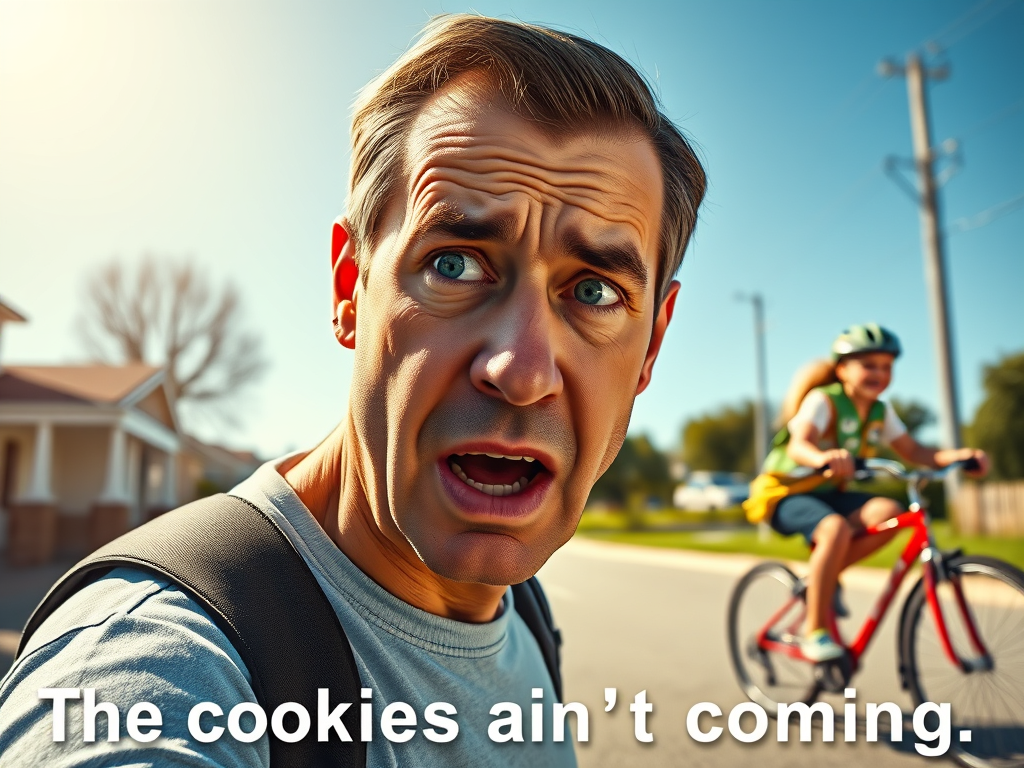
  • May 1: The cookies ain’t coming.

    May 1: The cookies ain’t coming.

    The following is based on real events. Some so disturbing, you may not want to go into this. Overall, it’s best you don’t:

    A post I tried to submit to my Ring chat for people in my area. A post that was rejected…I think the Ring company is in on it.

    If you read this and have any information on the underground cookie scamming business, contact your local Girl Scout troop leaders. These girls should be considered dangerous due to their convincing smiles and noble stories of heroic sisterhood responsibilities.

  • Size 15: A Journey

    Again…enjoy your sweet, sweet shoes you small-footed people. 😑

    Let us embark on a peculiar journey—quest, if you will—into the bizarre world of men’s shoes. For this story to be authentic, tis I who is the holder of the size 15.

    Yes, fifteen. A size that sounds less like footwear and more like those small “smart” cars in mid 2000s.

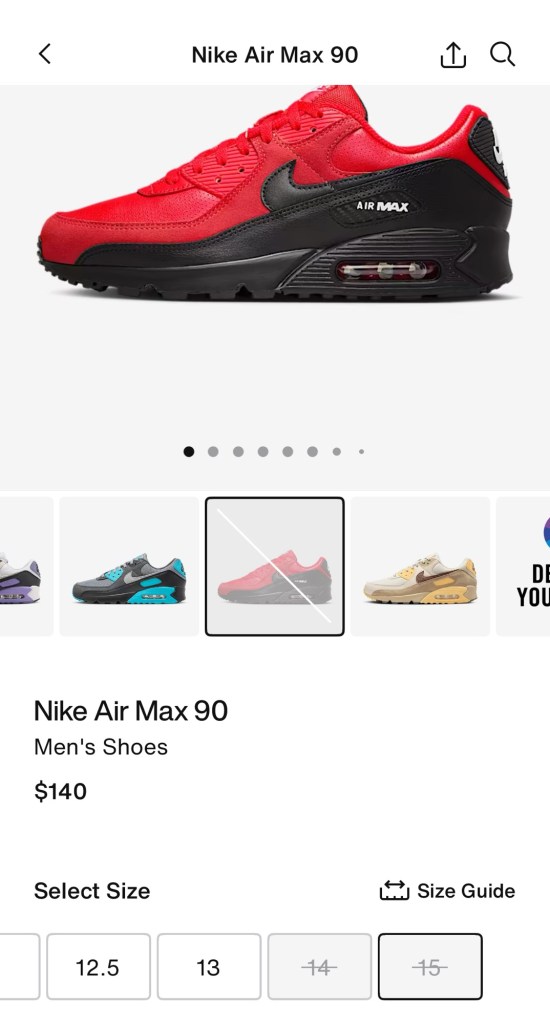
    I invite you, dear reader, to wander—into the labyrinth of online sneaker retailers: Nike, Adidas, New Balance, or whatever new age brand that was forged in the fires of Mount Hype last week. Choose your favorite Jordan, perhaps an Air Max 90 with a color scheme with just the right color palate it screams “you can’t get these!” and here in the sea of exclusivity: size 15? Sold out. Gone. Vanished like your motivation after eating a pack of ultimate stuffed Oreos.

    You might think, “Surely, this foot size would guarantee an overstock!” But no. It turns out that size 15 is a cruel paradox—rare enough to be inconvenient, yet common enough to be competitive. It’s like trying to find a left-handed coffee mug at a right-handed convention. They exist, but there are many people looking for the few that are around.

    Now, you may wonder, “Why on Earth should I care about this man’s odyssey?” Because (enter Forrest Gump accent): life is like a pair of shoes, my friend.

    Let me explain.

    Scarcity breeds value. Exclusivity inflates desirability. That same Jordan in a size 6? Might be on clearance next Tuesday. But a size 15? Full price and sold out in a minute. Maybe even resold for double. People camp out, not for warmth or camaraderie, but to clutch that elusive grail of rubber and laces. And suddenly—bam!—it’s not just a shoe, it’s a statement. A status symbol. A “flex.”

    This, friend, (we are friends now btw) … “Hello friend….Brother (Hulk Hogan voice) anyway…this “exclusivity” is what the sneaker world calls hype. And what we, in the world of hyper-fixation and compulsion might call… a trap.

    Because sometimes, what we want most isn’t actually what we want—it’s just what everyone else seems to want. Context is everything. That prized possession in one mindset? Utter trash in another. Like a prom tux at a Midwest wedding (jeans or cargo shorts only please) or a fork at a hotdog-serving venu—out of place, unnecessary, even ridiculous.

    So what if, just consider here, the thing you’re so obsessed with—the job, the relationship, the approval, the Yeezys—is only precious because of the mental lens you’re wearing right now? And what if, instead of focusing on doing less of the “bad” things, you simply added more of the good stuff—friends, purpose, vulnerability, laughter, a damn shrug the shoulders every once in awhile in the midst of stress 🤷🏻‍♀️🤷‍♀️?

    Maybe then, the cycle breaks on its own. Not through deprivation. But through distraction… by something better.

    Maybe your success isn’t about what “not to do,” but what to do.

    So next time size 15 is sold out, maybe take it as a reminder to think of me, or better the message (yes, the message): you don’t need that shoe. You need a new lens. And maybe take some time off and let little interferences go by saying “wow, look at those trees…just a blowing in the wind. How powerful those branches are to hold up to that.” Though we concluded on trees, we started with feet, my feet, and how through obscurity…we can find something useful, if we look for it.

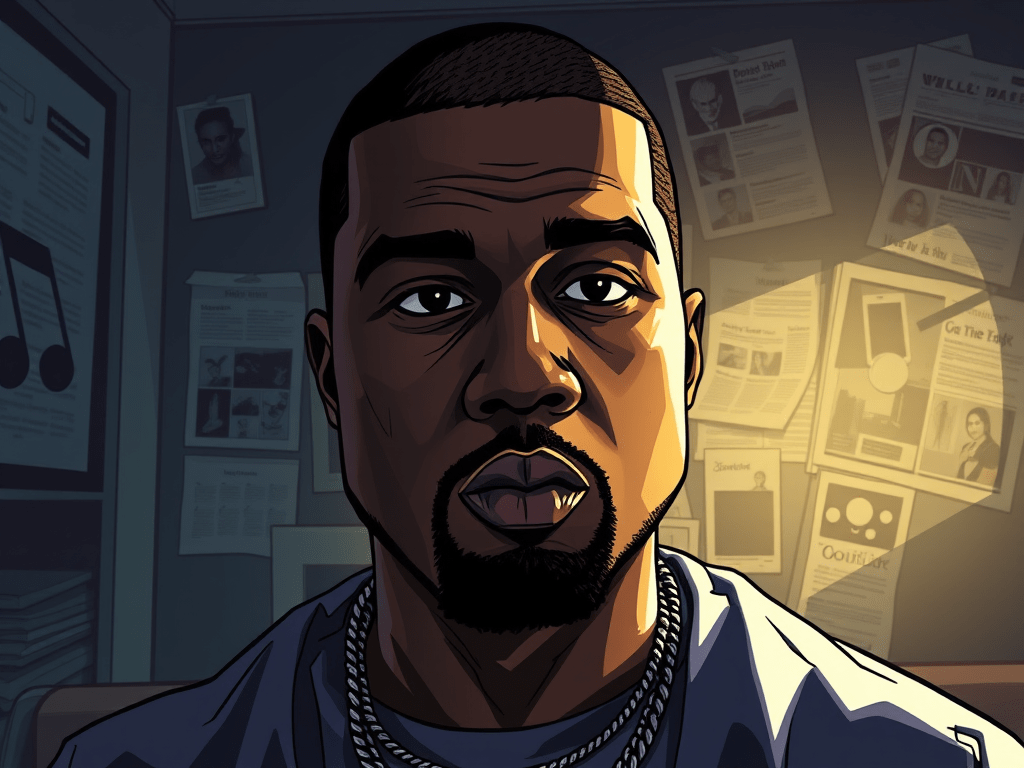
  • Ye: Loss. Brilliance.Faith.Trauma. and Yes-mental health

    Ye: Loss. Brilliance.Faith.Trauma. and Yes-mental health

    Genius, crazy, rich, antisemitic, controversial, chaos, egocentric, attention-seeking-These are all words that swirl around the name Kanye West. They’re also words that, if we’re being honest, have swirled around many of our names too, just without the a Kardashian and seven-part documentaries made about us.

    There’s something strangely egotistic in me to even have the urge I felt to even write this. Whether it’s a futile attempt to educate, or just an exercise in reflection, here I am, offering a few words on a person who seems to provoke something in nearly everyone. Ye makes it’s hard to look away.

    It was earlier this week—Monday and on to Tuesday—when news surfaced again about Ye. Or Kanye. Or Yeezy. You can read the article if you want to know the details. Personally I am still digesting the interview where he’s wearing a black White Supremest hood in a hotel room talking for 58 minutes about why he’s wearing the black hood in the first place. But that’s not really the point of this.

    What is the point?

    Maybe it’s this: despite all the controversy, all the confusion, this man keeps creating. Music. Fashion. Art. Controversy.

    And we keep buying it. After all, he didn’t get to be No.4 on the all time Hip Hop sales list by sucking at his craft. We keep listening. Some of us still remember the first time we heard Jesus Walks. For me, it was right after basic training in the summer of 2004. That song wasn’t just music—it was a a light in an otherwise dark era of music. Literally a light too, making one of his first singles be about Jesus, very light-bearing.

    But being good at a craft and rich doesn’t erase trauma. Creativity doesn’t cancel out pain. Nor does fame justify erratic behavior. But what happens when you start connecting the dots?

    What happens when we hear that childhood trauma shaped much of this man’s life—long before he had a platform to express it?

    What does that do to a boy, growing up and figuring out what it means to be a man?

    Kanye shared that he found magazines in his mom’s closet—magazines that shaped his understanding of sex, identity, and self-worth in ways that were far beyond his years. And long before the headlines, there was that little boy trying to make sense of what he saw, of all that he experienced.

    We all have experiences that shaped us, for better or worse. And here’s the kicker, we didn’t get to chose those experiences or decide how they affect us.

    So when we rush to label, to cancel, to condemn—what are we really doing? Are we holding someone accountable? Or are we just distancing ourselves from the parts of him that remind us of the parts we try to hide in ourselves?

    After all, isn’t pornography the bane of a young man’s existence these days? Are the adults now, failing to admit to themselves their own shaping of sex, relationships, what it means to be a man?

    Empathy is the bridge to forgiveness.
    Not because forgiveness means agreement. But because empathy allows us to see someone as someone—not as a headline, not as a cautionary tale, but as a human being formed by the sum total of his experiences.

    If you zoom in on Kanye West, you can isolate any number of choices, some of which are difficult to defend. But if someone zoomed in on your worst moment—your ugliest thought—what would they find?

    This isn’t a defense of bad behavior. It’s a reflection on how quick we are to misjudge when we don’t know the whole story.

    In C.S. Lewis’s The Great Divorce there is a man Len, a spirit who was a murderer in life, but now reconciled with God and is in Heaven. Another man, the Big Ghost believes he is a “good man” despite evidence that he was not. the Big Ghost character would be that of a man today, maybe you who demand’s recognition for being good, for doing right. Meanwhile that man, the character Big Ghost fails to repent and rejects heaven in the process. Yes, the murder remained in Heaven.

    Christ flipped the typical human narrative of what appears to be good may not be, and what appears to be distant or far from God may be the closest. Like Mr. West who has many faults, we too can choose to be the Big Ghost and cling to our own “goodness” and fail to relate to someone who is easy to categorize as a “bad” one.

    No person is defined by a single act—good or bad. If we believe otherwise, then we’re condemning ourselves every time we fail. We’re erasing nuance, context, and the messy truth that people are often doing the best they can with what they’ve got.

    To live with grace is to recognize that. It’s to understand that every decision is filtered through a complex web of history, beliefs, trauma, and identity. It’s not about excusing—but about seeing.

    And maybe that’s what Kanye, in all his chaotic truth, mirrors back to us. Maybe that’s why his story unnerves us. Because in his rawness, we’re forced to look at our own contradictions. Our own judgments. Our own worst parts. And if we’re honest, maybe they’re not as far from his as we’d like to believe.

    So the next time you’re tempted to judge—pause. Ask yourself this-is this about what they did, or what it stirred in me? Is this really about them—or is it about my own discomfort?

    Because the truth is, we all carry things that others wouldn’t understand. And we all hope—deep down—for grace when we least deserve it.

  • Care? Or think you SHOULD care?

    So, I was watching the news the other day—like a responsible adult who pretends they’ve got a handle on the world—and in true chaotic fashion, a political clip flashed across the screen. You know the kind: stern faces, firm declarations.

    My brain lights up: “this matters a lot!”

    Is this good?

    Is this bad?

    Is it secretly both?

    Is the media spinning it? Am I being spun? Who really is informed?

    And just like that, I was off—launched into a 25-minute internal monologue that involved four hypothetical scenarios, five imaginary conversations, and me mentally arguing with some “representative” I’m not even sure what they do.

    But let’s skip the 600-word descent into that madness and cut to the punchline:

    I didn’t really care.

    I thought I cared.

    I believed I should care.

    But deep down, beneath the mental gymnastics and obligatory sighs of concern… I didn’t.

    Not really.

    And you know how I knew that? It became extremely boring to try to care. I cared more about caring than the topic I was SUPPOSED to care about.

    Now before you report me to your local “Citizen Who Should Care” hotline, let me clarify.

    I do care. I care about people.

    I just didn’t care about whatever thing was being discussed by angry man in a suit.

    There’s a difference. A big one, actually.

    When you truly care about something, it moves you—it compels you to act, to reflect, to engage.

    When you think you should care, it’s usually because someone else told you it’s important. Or because X did. Or because the anchor on the news got Very Serious™ with his voice.

    So there I sat, mildly stressed, semi-guilty, sipping coffee and wondering why I was so mentally invested in something I had no intention of doing anything about.

    And then it hit me: I was borrowing someone else’s care. Like a care-on-loan program and I have a horrible emotional credit score. The cost of the interest would floor me if I took that on.

    But here’s the strange and glorious twist: admitting I didn’t care, it gave me peace to be that honest.

    Because what I do care about is how people respond to news like that. My heart isn’t in the headlines—it’s with the person who’s afraid because of them, who’s confused, or angry, or overwhelmed.

    Even when I don’t agree with people’s perspective it’s nice to hear their conviction and walk alongside them.

    So instead of funneling all my energy into a political opinion I didn’t even want, I redirected it to empathy.

    And now, the real punchline—maybe the only part you need to hear:

    You only have so much energy every day.

    Which means it’s a precious resource. Like toilet paper during a panic (or eggs these days).

    So ask yourself:

    Do I actually care?

    Or do I just think I should?

    Practicing that tiny bit of honesty can save you hours of mental spiraling (refer back to my loan and interest metaphors, I was proud of that one).

    Because maybe you don’t care about that thing.

    But there is something else you care about a lot. And living in alignment with that thing makes you rational, grounded, and a lot less likely to throw your remote at the news.

    So go ahead—care less, on purpose.

    And care where it matters.

    Thank you for attending my TED Talk slash coffee-fueled ramble.

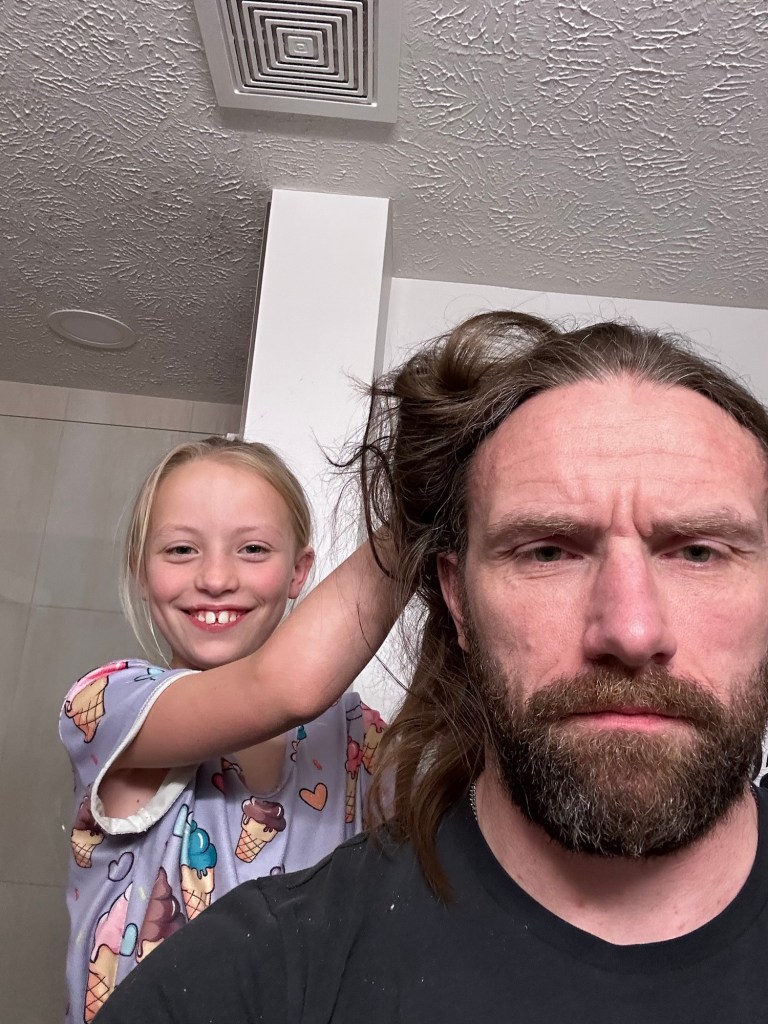
    A pic of me doing anything other than watching the news…..maybe she’ll braid it.
  • Iphone and Emotional Intelligence

    So, I put my car in drive. Again. I’ve driven to the same destination about five times now. Maybe more. I don’t know—who’s counting?

    Well, My iPhone is.

    I start moving, and then I back up—because I’m just a thrill-seeker like that—and BAM: the familiar little chime goes off.

    “Gym is nine minutes away.”

    Every. Single. Weekday.

    (Ok, not EVERY day? But you get it)

    It’s like my iPhone gaslights me.

    “Im not following your every move, you’re just paranoid.” It knows. It knows when I leave the house. Worse yet, I think it knows I know. (But I also know it knows I know).

    Sundays it whispers, “Church, 13 minutes”, like it’s trying to gently nudge me toward salvation. Other days it nudges me toward capitalism:

    “Office, 11 minutes.”

    And if I’m feeling in need of overpriced snacks:

    “Gas station, four minutes.”

    So what does this say about the iPhone? More importantly, what does this say about me, a supposedly evolved and deeply complex human being with a fully developed prefrontal cortex (let’s hope)?

    It says… my phone learns faster than I do.

    My iPhone doesn’t need a life coach, a therapist, or a hundred repetitions of the same bad idea before it goes, “Hey, this is a pattern.”

    Meanwhile, I’m over here needing a divine intervention and disabling guilt to acknowledge, “Oh, maybe I do this a lot.”

    But here’s the thing: the iPhone doesn’t have feelings. It doesn’t wake up and re-think, “I don’t feel like going to the gym. Maybe today’s a bakery day.”

    Nope. It doesn’t negotiate. Doesn’t justify. Doesn’t self-sabotage.

    It doesn’t wonder if the treadmill is judging it or if the shirt it’s wearing was actually washed (clean and dirty clothes getting awfully close to one another).

    It just sees routine, data, habits. Predicts and then Executes.

    So again, why don’t I learn like an iPhone? Why do I need the same lesson 30, 40, 184 times before it even occurs to me that maybe, just maybe, this is a bad idea?

    Here’s where I stand: good habits are boring, and bad habits are spicy.

    Take doughnuts, for instance. I didn’t need 40 tries to decide I liked doughnuts. That lesson was locked in immediately.

    Ask my mother—she has the smashed-cake baby photos to prove it.

    My daughter? My nephew? One doughnut and they’re in a committed relationship.

    But that same reward system? It works a little too well with gossip. Or swearing. Or skipping leg day.

    Somewhere, somehow, there’s a reward hiding in these less-than-ideal behaviors. A tiny hit of dopamine, a splash of excitement, rebellion even.

    So maybe the real issue isn’t just stopping the bad—it’s finding something good instead.

    Because if “gym” is less rewarding than “bakery,” well then, I can’t exactly trust my feelings, can I?

    My internal compass is calibrated to pleasure, but maybe the compass is a little… off.

    Which brings me to the haunting question:

    How many tiny, subpar decisions am I making every day that are driven by the lower, pleasurable me, versus the ideal gym-goer my iPhone might think I am. (Or at least, think that I think I am).

    Not the huge, dramatic habits—the little ones. The ones that snowball. The ones that come with a side of guilt.

    How many times does it take to change a behavior?

    Thirty?

    Forty?

    Or do I just need to become more like my iPhone?

    Because honestly… my iPhone figured it out in five.

  • 4:58 AM

    4:58 AM

    4:58 AM, Driving, and the Revelation
    Why driving to the gym turned into a full-blown spiritual awakening (with carbs).

    It’s 4:58 AM. Driving to the gym. Enough pre-workout in my stomach and english muffin in my gut to fuel a baby elephant.

    Then—right there between two changing lights, accelerating and then decelerating because someone decided to time the lights that way—I have a thought:
    “Why do I seek attention from people when I’m actually pretty content being alone?”

    Going to the gym always gives me anxiety because I become painfully aware mid-squat there are other people in here, am I doing this workout good enough?

    Ah yes, an all-too familiar beginning of every great mental spiral.

    For a fleeting, smug second, I think I’ve achieved enlightenment. I’ve transcended the need for external validation. Why Am I going to the gym, I am in no need of “bettering” myself. I am a lone wolf, a peaceful monk in small shorts, the Dalai Lama of the road right now.

    But then the second punch of a one-two combo… floors me.

    What if I don’t seek attention because I’m “over it”—what if I avoid it because I’m afraid of rejection?
    What if I’ve just become a professional emotional gymnast, doing quiet backflips to stay liked, relevant, and never, ever left out?

    Wait, is that what I am doing here, right now?

    Cue: Deep thoughts. Mirror glances. Internal debates that sound like two Jr. high kids trying to get an A in speech class.

    “Well you just want people’s attention”

    “Nu-uh”

    “Uh huh”

    It’s all in the Dough.

    There’s cheap bread—$1.78 white fluff. It’s fast. It’s easy. It tastes great for six seconds.
    Then there’s the $6 sprouted grain, sourdough, rustic spiritual metaphor bread. Hard to chew. Takes time. Might change your life.

    The actions might look the same—going to the gym, being nice, dressing up—but why do I do these things? Am I living from a place of wholeness? Or just baking my self-worth in other people’s approval ovens?

    And the, because it was Good Friday, Jesus shows up in the metaphorical bakery:
    “The world will hate you because of me.”

    Brain, please. It is not even 5 AM.

    But also… you got me there. You can’t follow Christ and be everyone’s favorite. Not forever. Eventually, the values split. The applause fades. The unsubscribe buttons get pressed.

    And that’s where rejection becomes not a curse, but a reminder. It reveals where we anchor our worth. Are we in the world instead of eternity?

    So now, foot on the accelerator, I realize:

    • It’s not about if rejection happens.
    • It’s about when it does—who am I really living for?

    Conclusion:
    If I’m going to be misunderstood, misread, or mildly unpopular, let it be because I chose truth over trend. My soul over spotlight. Jesus over clout.

    And if it takes a few extra seconds stopping at every traffic light between my house and the YMCA and a loaf of overpriced bread to remind me of that?

    Worth it.


    Liked this?
    ✨ Share it with someone who needs a holy wake-up on their morning commute.
    💬 Drop a comment: What’s your $1.78 bread these days?
    🍞 Choose the good bread. Spiritually and literally.

  • Friends?

    I Bet Myself $10 I Could Write This Without Sounding Pathetic—So Far, It’s Not Looking Great

    Let’s start strong: I’m terrible at maintaining friendships. There, I said it. The first step is admitting it.

    And yes, people like to say “Oh it’s just the ADHD!” like that’s a Get Out of Social Jail Free card. But to me, it mostly just feels like I’m selfish. Not “eat the last slice of pizza” but more like “I forgot you exist for three months.”

    I work a lot. I start a thousand projects, and I’m pretty sure I dodge emotional intimacy like it owes me money. It’s not personal—I just have a natural gift for overcommitting to tasks leaving friends with scraps.

    I get these bursts-“look at me adulting!” bursts—where I reply to texts, maybe even initiate plans. Then…like a turkey trying to fly, come crashing down to my oversaturated itinerary. No explanation. Just gone like Freaks and Geeks after one season.

    People say, “Be intentional. Make others a priority.” Which I am successful at….for like 15 minutes. Then I’m back in my little project spiral, reminding myself that in the movie of someone’s life, I wouldn’t even get credited as “Guy With Coffee, Scene 3.”

    Apparently, friendship is also a struggle for other middle-aged men. Shocking, I know. But seriously—have you tried doing life lately? Be a parent, be a “good” partner, work, pay bills, try to stay somewhat hydrated… (dare I mention fitness level?) and THEN fit in meaningful friendships? What am I, a wizard?

    Speaking of wizards, aren’t they the best character depiction? Like, a wise-sage of a human with the ability to produce element-altering forces usually for the good on some hero’s journey- all that power and they are rarely the main character…just saying.

    Anyway, At this point, it’s not sadness. It’s more like scientific observation. I’m weirdly okay not including many people in my life outside of my immediate family (whom I also sometimes emotionally ghost). There are so many plates spinning that if someone threw me a friendship plate, I’d probably just duck and hope it misses.

    So here’s the existential gem: Is it better to have no friends than be a half-hearted, invisible friend? Because if so, I’m basically doing my friends a favor by not being around. You’re welcome.

    I love my friends, their kids, their families—and still I disappear. Not out of malice, but out of… I don’t know. Life? Guilt? Google Calendar? This new Solitaire game on my phone?

    So what’s the solution? I think it’s different for everyone. We all have to decide what kind of human we want to be—even if our social skills are stuck performing at a Windows 95 speed.

    From a biblical standpoint, Christ modeled that a friend is someone who wants good for you. Now that I can do. I may not show up to brunch, but if you post something unhinged on Facebook, I will absolutely message you “bro… no.” That’s love, right?

    We may not hit the bars or get into late-night mischief anymore (middle-aged sleepiness won’t allow for that sort of energy), but being there when it counts. That’s the kind of friendship I can still show up for.

    Please ask me for a favor, I can do favors.

    Love is a verb. It requires action. Sometimes that action is a hug. Sometimes it’s a blunt “You’re being an idiot and here’s why.” Either way—it counts.

    So yeah, maybe I’m not the fuel source of group chats, but I still want good things for people. I still try, in my own over-done, inconsistent way.

    And you know what? I think I pulled it off. Kept the pathetic levels low. Ten bucks stays in my pocket—and honestly, that’s the most responsible financial move I’ve made all week.

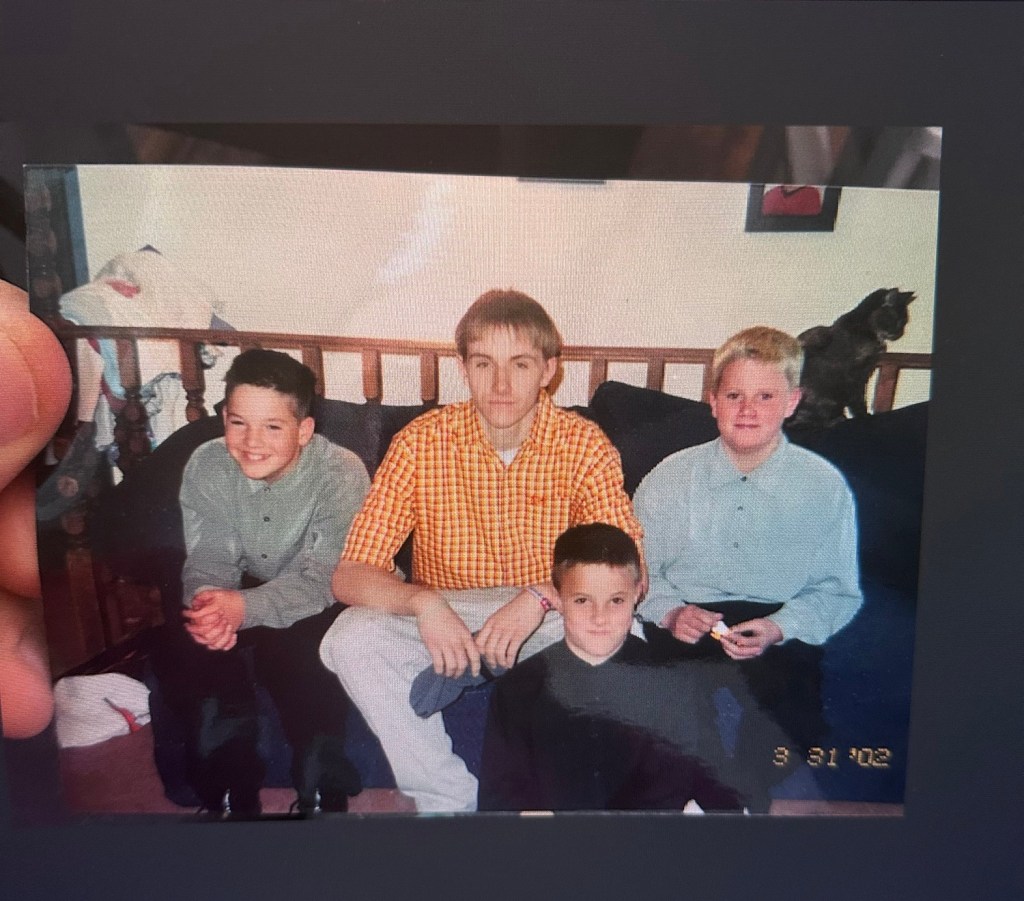
    Childhood pic….just because.