Elliot, a tall, slender man wearing a large untucked shirt splattered with various mediums of materials sat hunched over his canvas. In his shirt pocket, the box of cigarettes rests on the chest going in and out, deep breaths. His fingers smudged with oil paints digs into the pack, fumbling in the box spreading a dark oil over the bright white filters ends.
His art never seemed to land quite right.
The air in his studio was thick with turpentine and frustration.
Dozens of unfinished paintings leaned against the walls, each abandoned just shy of completion, their potential strangled by his relentless pursuit of perfection. He had spent weeks, months—sometimes even years—on a single piece, only to despise it in the end. Like his cigarettes, the weight of expectation pressed against his chest, also like the smokes, a suffocating reminder that his art no longer felt like creation but a battleground between ambition and failure.
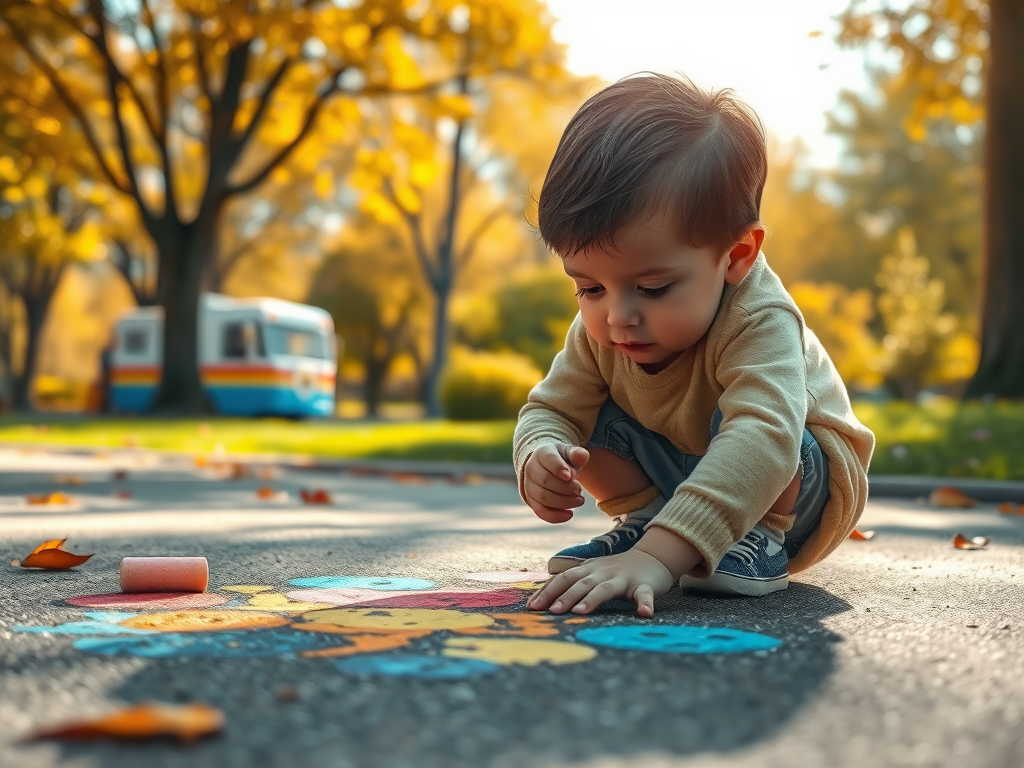
One afternoon, weary from the endless cycle of doubt and revision, Elliot stepped outside for air. The city bustled around him, indifferent to his turmoil. His feet moved without direction until he found himself at the park, where laughter and life carried through the crisp autumn air. There, just off the pathway, a child crouched, a piece of chalk clenched in his tiny fist, his face scrunched in concentration.
Elliot watched as the boy’s hand glided across the pavement, sweeping blues and yellows into the gray stone with an ease that seemed almost careless. A streak of orange, a swirl of pink—no hesitation, no erasures, just movement. The boy paused, squinting at his creation. For a moment, Elliot thought he recognized that familiar doubt, that paralysis of knowing something could be better. But then, just as quickly, the boy dropped the chalk and sprang to his feet.
Without a second glance at his work, he bolted across the park, following the unmistakable chime of an ice cream truck. Elliot stood there, stunned. He waited, half-expecting the boy to return, to kneel back down and tweak a line or blend a color more carefully. Minutes passed. The chalk rested where it had fallen, abandoned like the artwork itself.
Curiosity got the best of him. He turned his gaze from the unfinished drawing and scanned the park, spotting the child sitting cross-legged on a bench, an ice cream cone clutched in his sticky fingers, laughing with a group of friends. Elliot hesitated for only a moment before approaching.
Kneeling, he extended the chalk towards the boy. “Do you want to finish your drawing?”
The child barely glanced up, licking a drip of melting vanilla from his hand. “It’s done.”
Elliot blinked. He turned his head slightly, looking back at the pavement where the colors sprawled in wild, unapologetic shapes. He had expected an explanation—some reason, some justification. Instead, there was only certainty.
It’s done.
Those two words landed heavier than all the years of critiques, rejections, and self-imposed expectations. He had spent his whole life trying to make something perfect, something worth admiring, yet here was a child who created simply for the joy of it. And then, when the joy was over, he let it go.
For the first time in years, Elliot felt something shift inside him. A loosening. A breath of relief.
A week later, he started working part-time at a coffee shop. Not because he wanted to quit art, but because he wanted to make art without forcing it to pay his rent. He wanted to create without the suffocating fear of failure. And so he did. Some paintings he finished in a day. Others he never finished at all. And for the first time in his life, he was okay with that.
Because sometimes, you don’t need to perfect something to make it worth creating. Sometimes, it’s done when you decide it is.
 From Where I Stand
Leave a comment