Tag: parenting

  • Epiphany at 11:53 PM

    Epiphany at 11:53 PM

    It was probably my third extra spoonful of the creamy natural peanut butter at 11:53 PM that pushed me over the edge.

    I didn’t feel good at that point.

    Photo by Karola G on Pexels.com

    It may have been the packed caloric intake within a few brief moments of shoveling in spoonfuls of the creamy/grainy goodness combined with the last bit of Diet Pepsi that zoomed me past my comfort zone. It may have been the fan blowing on my feet thereafter causing me to be an uncomfortable temperature.

    Whatever it was, the conditions were ripe for, you guessed it, a late-night critical thinking session.

    This particular one wasn’t anything special, simply a theological debate in my head about sin, what it means to live, and what in my life needs to change that is holding me back from more.

    I don’t necessarily want “more” of any one thing, specifically. I want more space in my stomach for more peanut butter probably. I wanted smaller spoons that I count up when eating the heavenly legume mixture, sure.

    I know that it was here, chilly, uncomfortable, in bed where it hit me.

    “It’s not about me.”

    So, like any rational and uncomfortable person would do, I went to my office to write a blog post about it.

    This idea was more than just, “not about me” in the sense of doing good for others. But literally, at the deepest and purest place, my desire to do good isn’t about the version of myself that thinks it needs to not be about me. But from the view of God himself, the me he sees and knows, knows that for life to be full, for things to workout at the highest level, I need to give up the focus of my life being on my life and to seek Him.

    So, there it is. A verse I have heard a thousand times, now hitting my vulnerable and sleepy self like a ton of bricks. Like a release from my own body, like the Hulk being released from Bruce Banner’s body in the Avengers: End Game.

    For a brief second, I saw myself outside of myself and sat with the words of life. I saw my body lying there, thinking about myself, what I was going to do the next day, what sins I have committed the day before, what I need to do better on. I saw me thinking about me and felt pity for the guy I saw because of how off the mark he was here.

    Why would I get sad about losing my life if in fact, it has always been true that to find one’s best and only life is to give it up?

    I briefly thought of the commercials and movies I watched growing up. You know, during the good ol’ 90’s, which depicted a life best lived in scenes. One scene in particular was in the movie Father of the Bride.

    In the scene I recall from time to time (for no reason at all) has Steve Martin talking to his about-to-bed-wed daughter outside and I think it starts to snow. I think as a father that would be a really pivotal moment, one that I recall frozen in time. However, then I realized the movie was put out in….1991!

    1991! Are you serious?

    That means that in that scene, even if it was a real person, which is safe to assume some father at that time was going through it, and that here in 2025, that movie is 34 years old. That means, the already aged father of a 20-something getting married is now probably seeing his grandkids getting married and having children. (Also it means that Steve Martin does not age, he’s been an old man since he was born.)

    The scenes of my own life will soon be in the past and life will continue on, thus removing any significant moment I hold now to eventually be nothing because of my own passing and then my child’s passing, and her kids passing etc.

    We all age, move forward. Governments grow and fall. Things come and go. There is a season for this and a season for that. Nothing in this world lasts very long anymore, not to mention, lasts forever. Not even the most significant legacies. Warren Buffet’s empire will be gone in a blink of an eye meanwhile there is some sea turtle out there who saw it all come and go.

    So then, what stops me from falling into the abyss of nothingness? It’s that none of this, none of the world, none of the plans and outcomes of God’s plan found in man is about my life as MY life. But for HIS plan and intended outcome, the only true and real thing that will last.

    Yes, our lives have deep and eternal meaning. Yes, it serves us well to live “good” lives and to honor others as ourselves and serve and be of good cheer and be grateful for the moment. Yes a man who is blessed can go ahead and enjoy his blessings. However, life isn’t about these moments as the main plot point. One doesn’t live “good” for it’s own sake or for the pleasure of the man alone, but one lives “good” because he knows what is true and that what is true is from the authority on truth alone.

    Christ says He is the way, the truth, and the life (John 14:6). If this is to be true, then those who abide, turn to, trust in, apply his teachings, will have a “good” life as a result.

    I am not asking you to do anything here. Just sharing the thought that when you meditate on life from time to time, realizing that all of what there is now fading, shouldn’t cause massive panic or regret, even sadness, but can bring joy. Joy can be found in the reality that all things pass. All things except the Word, the Word that was brought to life. The Word manifested in Christ who came and walked this planet.

    Jesus. A real man. A real God. A relational God who is choosing to share with His people the truth that to find your life is outside of the you who finds it. But is only found when you come to the conclusion that your life isn’t about you, but Him.

    From here, truth can spread into decisions and perspectives that can alter decisions. You might find that you can let things go. You might find that what scripture says to do-to think of others as yourself as one thing, will become a natural process as you now think less of your own satisfaction as the ultimate outcome and see your life now found in Christ who brought redemption from the dark thoughts of this world alone- the thoughts that are riddled with fear, greed, lust, gluttony (which with peanut butter and my overindulgence demonstrated why we should NOT do that).

    When people talk about Christianity and what a Christian should and should not be doing, it’s not about us choosing from the place of us, the us that believed in the world as the point, but when we change our viewpoint, the things a Christian, or believer in Christ SHOULD do become more natural.

    We are natural creatures meaning we live our nature just like a dog lives theirs. What that nature is starts with how one views their life, which Christ reminds us is only truly found when someone gives up their life as their own and as a result, lives as Christ tells us in the Gospels.

    Now the passing of the peanut butter provides relief for the the me that chose to eat too much. The chilly air is no longer dominating my sensations (because I am in my office for one thing). But the negative sensations of my life are passed and I can feel a temporary relief. All the while knowing that there will be more discomfort right around the corner.

    It doesn’t really matter though, because if my life isn’t found as my life, then I can only find true relief in the Scriptures that indicate what vantage point one must truly see to live the best life.

    And it isn’t at the bottom of a 16 oz Smuckers Natural Peanut butter jar.

  • Camping Theology and the Great Disconnect.

    Camping Theology and the Great Disconnect.

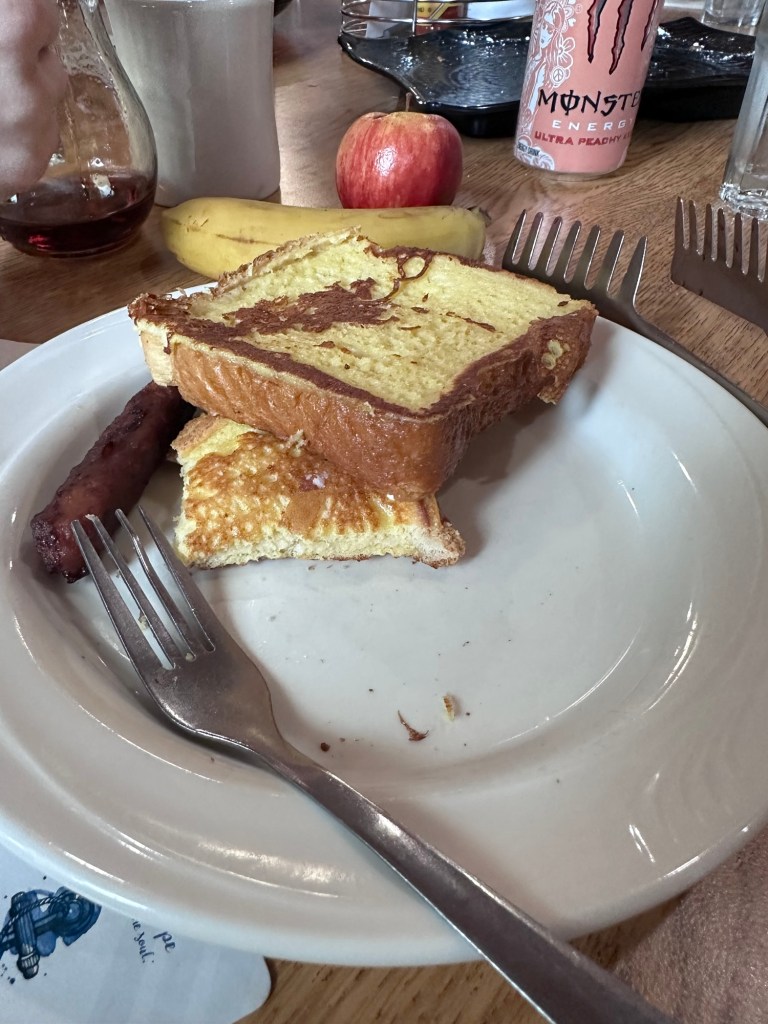
    A hearty breakfast before worship (God bless it).

    What is it about trees, open land, a pile of pancakes, a dining hall with a modern, cabin-esc vibe, basketball courts and highly weathered balls, not to forget, the ever-humbling Pickleball court that turns even the proud into the breathless… that makes it all feel so magical?

    No, this isn’t just any campsite. This is church camp.

    And yes—I’m 39 years old. I know. Church camp isn’t just for teens with underdeveloped frontal lobes. It’s for grown adults with student loans, aging knees, and deep questions about meaning, suffering, and why camp mattresses are still apparently made from recycled plastic cups.

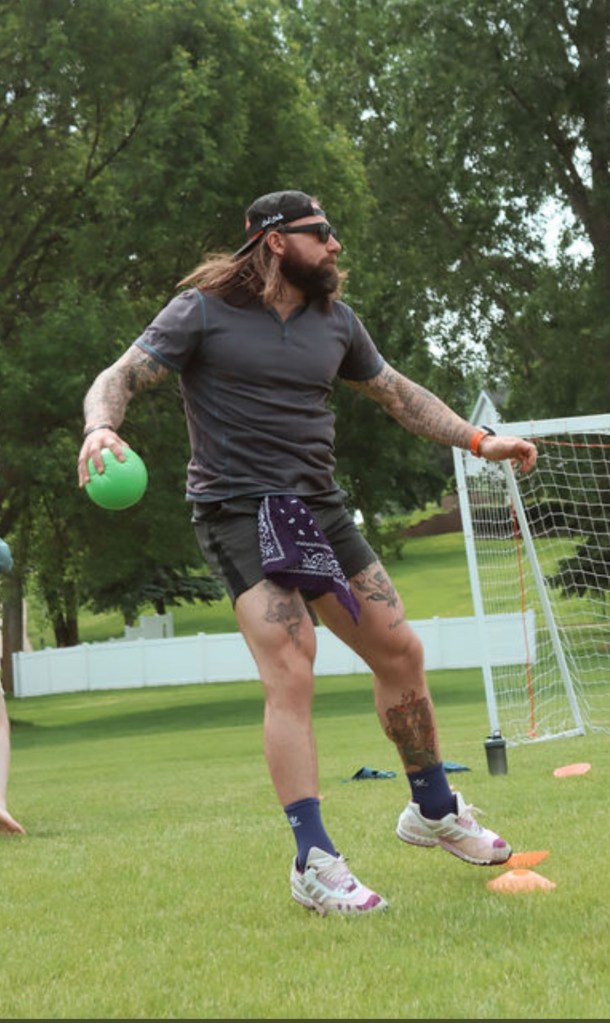
    No. My foot was not over the line. (Photo Credit: Bre Gray- bregrayphotography.pixieset.com)

    At first glance, it’s a recipe you wouldn’t expect to nourish the soul: communal sleeping with nine other guys, unreasonably early mornings, and food so rich and hearty it feels like we’re dining with medieval royalty (minus the beheadings, plus a lot more cheese). And yet, somewhere between the 16-hour days, the constant change of sweaty clothes, and the silverware I didn’t have to wash, I remembered something.

    Every day had rhythm at camp: morning and evening worship services, time carved out for silence and scripture, group discussions about faith—where it’s lived, where it’s lost, and where we’re still fumbling in the dark. But it’s not just the programming. It’s what happens when we step outside the script of “real life” and into something slow, and never ending.

    At 39…my back starts to feel it.

    Be honest: our daily lives are designed to distract us from ourselves. We march through schedules, crush goals, pay off student loans (until the end of time), scroll endlessly, and quietly wonder, “Is this it?”

    But camp—the right kind of camp—brings you face to face with your own soul. You can’t outrun it out there. There’s nowhere to hide when you’re sitting around a well-crafted cabin table, under a star-pierced sky, holding a thermos of Minnesota’s finest tap, and realizing how long it’s been since you actually felt still.

    One of the biggest things I see as a therapist?

    People are disconnected from themselves.

    Not the version they present to the world. Not the curated personality or the productive employee or the “good” parent. I mean the real them. The one that’s still under there somewhere, buried beneath bills and burdens and the belief that if we just push hard enough, we’ll eventually feel okay.

    But here’s the catch:

    We don’t know why we do what we do.

    We think we know. We tell ourselves stories.

    But often, those stories aren’t true.

    That’s why reflection—real, sometimes uncomfortable reflection—is so important. Because if we don’t pause and reassess, we wake up one day bitter, cynical, and convinced that the best parts of life are behind us.

    Being with middle school through high school students this past week reminded me what it was like to be joyous and live in the moment. They had within them a camaraderie that we often don’t find in the routines of everyday life. These students had each other and they had, well, connection.

    Connection, especially the kind that touches the deepest part of our being, is what we were made for. Not just connection with people (though that’s crucial). But connection with God—the Creator who sees through all our layers and still longs to be close.

    And when we don’t connect with Him?

    We find substitute relationships:

    – With our careers

    – With approval

    – With achievement

    – With control

    But those things will fail us, sooner or later.

    They make terrible gods and even worse friends.

    Yet life isn’t shallow. Not at all. It’s deep and eternally significant. Every moment. Every choice. Every quiet ache.

    The tragedy is not that life lacks meaning, but that we rarely stop long enough to see how meaningful it actually is.

    And no, you don’t have to be at a camp with creaky bunks and bug spray in your hair to realign. You can pause for five minutes between Zoom calls, or in the carpool line, or right before you open another Microsoft Word doc, and simply ask:

    “What’s really going on in me right now?”

    “What do I want to be about today?”

    “God, are You near—and am I listening?”

    If you do that daily—even just for a week—you might be surprised. You might start to see your life with fresh eyes. You might remember that you are more than your resume, your obligations, or your debt-to-income ratio.

    Because here’s the truth:

    You can’t have a great marriage without effort.

    You can’t be a great athlete without training.

    And you can’t cultivate a soul without intentional time with the One who gave it to you.

    From where I stand, the greatest lack in most people’s lives is not time, not opportunity, not intelligence, or even love.

    It’s spiritual disconnection.

    From God. From truth. From themselves.

    But the good news?

    You can reconnect.

    Right now.

    No reservation needed.

    And maybe—just maybe—that’s where the real magic begins.

  • To be honest…

    Honestly? I sat down to write this with zero agenda. Nothing. My genius said, “Just start writing and see what happens.” Always a solid strategy.

    So here I am—two lines deep—and already staring at the blinking cursor like it’s judging me.

    Idea one: What happens when the worst thing in life happens?

    Nope. Too heavy. Not today.

    Okay okay, here’s one: What happens…

    Gross. That’s so vague it could be a free online article…oh.

    Wait—I’ve got it:

    I have absolutely no idea. That’s the idea.

    Yep. No one knows the answer. Not me, not you, not that podcast host with the perfect bookshelf background (which I have-less perfect however). Not your favorite fitness influencer, your mom Facebook group, your stylist, or that one guy at the gym who somehow always has advice for everything except leg day (and diet).

    Forgive my little neurodivergent detour here, but when we’re trying to solve problems we usually end up drowning in opinions, frameworks, TED Talks, and cold plunges. Everyone has a hack, and yet… nothing changes.

    So how the heck are we supposed to move forward and live a meaningful life if we don’t even know what “solved” looks like?

    Here’s a thought: maybe we need to zoom out. Like… way out. Maybe we stop looking just at our brains, or our culture, or even our bodies—and take a peek at that deep, mysterious, spiritual part of ourselves.

    Yep. One of those posts.

    Don’t roll your eyes just yet.

    Because every day, you’re solving problems—some big, some small, some that just involve whether or not you can justify buying another pair of kicks/drip. Behind all those decisions is something deeper—something that drives you, that gives your life meaning.

    Dallas Willard—brilliant theologian and philosopher—once said (and I’m paraphrasing here): “What your soul is connected to determines how well your soul is.”

    Translation: If your soul is tied to your job, your team winning the playoffs, your group chat, or your Sunday routine, then your soul is gonna ride the rollercoaster of those highs and lows. But if it’s rooted in something deeper—like, say, the Creator of the whole show—then there’s a steadiness, a sense of “home,” even when things get shaky.

    Yes, even you overzealous people forgetting to turn off the news every once in a while.

    So yeah. No clear answers. No five-step plan. Just a thought worth sitting with.

    And honestly? I think it’s worth it.

  • Size 15: A Journey

    Again…enjoy your sweet, sweet shoes you small-footed people. 😑

    Let us embark on a peculiar journey—quest, if you will—into the bizarre world of men’s shoes. For this story to be authentic, tis I who is the holder of the size 15.

    Yes, fifteen. A size that sounds less like footwear and more like those small “smart” cars in mid 2000s.

    I invite you, dear reader, to wander—into the labyrinth of online sneaker retailers: Nike, Adidas, New Balance, or whatever new age brand that was forged in the fires of Mount Hype last week. Choose your favorite Jordan, perhaps an Air Max 90 with a color scheme with just the right color palate it screams “you can’t get these!” and here in the sea of exclusivity: size 15? Sold out. Gone. Vanished like your motivation after eating a pack of ultimate stuffed Oreos.

    You might think, “Surely, this foot size would guarantee an overstock!” But no. It turns out that size 15 is a cruel paradox—rare enough to be inconvenient, yet common enough to be competitive. It’s like trying to find a left-handed coffee mug at a right-handed convention. They exist, but there are many people looking for the few that are around.

    Now, you may wonder, “Why on Earth should I care about this man’s odyssey?” Because (enter Forrest Gump accent): life is like a pair of shoes, my friend.

    Let me explain.

    Scarcity breeds value. Exclusivity inflates desirability. That same Jordan in a size 6? Might be on clearance next Tuesday. But a size 15? Full price and sold out in a minute. Maybe even resold for double. People camp out, not for warmth or camaraderie, but to clutch that elusive grail of rubber and laces. And suddenly—bam!—it’s not just a shoe, it’s a statement. A status symbol. A “flex.”

    This, friend, (we are friends now btw) … “Hello friend….Brother (Hulk Hogan voice) anyway…this “exclusivity” is what the sneaker world calls hype. And what we, in the world of hyper-fixation and compulsion might call… a trap.

    Because sometimes, what we want most isn’t actually what we want—it’s just what everyone else seems to want. Context is everything. That prized possession in one mindset? Utter trash in another. Like a prom tux at a Midwest wedding (jeans or cargo shorts only please) or a fork at a hotdog-serving venu—out of place, unnecessary, even ridiculous.

    So what if, just consider here, the thing you’re so obsessed with—the job, the relationship, the approval, the Yeezys—is only precious because of the mental lens you’re wearing right now? And what if, instead of focusing on doing less of the “bad” things, you simply added more of the good stuff—friends, purpose, vulnerability, laughter, a damn shrug the shoulders every once in awhile in the midst of stress 🤷🏻‍♀️🤷‍♀️?

    Maybe then, the cycle breaks on its own. Not through deprivation. But through distraction… by something better.

    Maybe your success isn’t about what “not to do,” but what to do.

    So next time size 15 is sold out, maybe take it as a reminder to think of me, or better the message (yes, the message): you don’t need that shoe. You need a new lens. And maybe take some time off and let little interferences go by saying “wow, look at those trees…just a blowing in the wind. How powerful those branches are to hold up to that.” Though we concluded on trees, we started with feet, my feet, and how through obscurity…we can find something useful, if we look for it.

  • Care? Or think you SHOULD care?

    So, I was watching the news the other day—like a responsible adult who pretends they’ve got a handle on the world—and in true chaotic fashion, a political clip flashed across the screen. You know the kind: stern faces, firm declarations.

    My brain lights up: “this matters a lot!”

    Is this good?

    Is this bad?

    Is it secretly both?

    Is the media spinning it? Am I being spun? Who really is informed?

    And just like that, I was off—launched into a 25-minute internal monologue that involved four hypothetical scenarios, five imaginary conversations, and me mentally arguing with some “representative” I’m not even sure what they do.

    But let’s skip the 600-word descent into that madness and cut to the punchline:

    I didn’t really care.

    I thought I cared.

    I believed I should care.

    But deep down, beneath the mental gymnastics and obligatory sighs of concern… I didn’t.

    Not really.

    And you know how I knew that? It became extremely boring to try to care. I cared more about caring than the topic I was SUPPOSED to care about.

    Now before you report me to your local “Citizen Who Should Care” hotline, let me clarify.

    I do care. I care about people.

    I just didn’t care about whatever thing was being discussed by angry man in a suit.

    There’s a difference. A big one, actually.

    When you truly care about something, it moves you—it compels you to act, to reflect, to engage.

    When you think you should care, it’s usually because someone else told you it’s important. Or because X did. Or because the anchor on the news got Very Serious™ with his voice.

    So there I sat, mildly stressed, semi-guilty, sipping coffee and wondering why I was so mentally invested in something I had no intention of doing anything about.

    And then it hit me: I was borrowing someone else’s care. Like a care-on-loan program and I have a horrible emotional credit score. The cost of the interest would floor me if I took that on.

    But here’s the strange and glorious twist: admitting I didn’t care, it gave me peace to be that honest.

    Because what I do care about is how people respond to news like that. My heart isn’t in the headlines—it’s with the person who’s afraid because of them, who’s confused, or angry, or overwhelmed.

    Even when I don’t agree with people’s perspective it’s nice to hear their conviction and walk alongside them.

    So instead of funneling all my energy into a political opinion I didn’t even want, I redirected it to empathy.

    And now, the real punchline—maybe the only part you need to hear:

    You only have so much energy every day.

    Which means it’s a precious resource. Like toilet paper during a panic (or eggs these days).

    So ask yourself:

    Do I actually care?

    Or do I just think I should?

    Practicing that tiny bit of honesty can save you hours of mental spiraling (refer back to my loan and interest metaphors, I was proud of that one).

    Because maybe you don’t care about that thing.

    But there is something else you care about a lot. And living in alignment with that thing makes you rational, grounded, and a lot less likely to throw your remote at the news.

    So go ahead—care less, on purpose.

    And care where it matters.

    Thank you for attending my TED Talk slash coffee-fueled ramble.

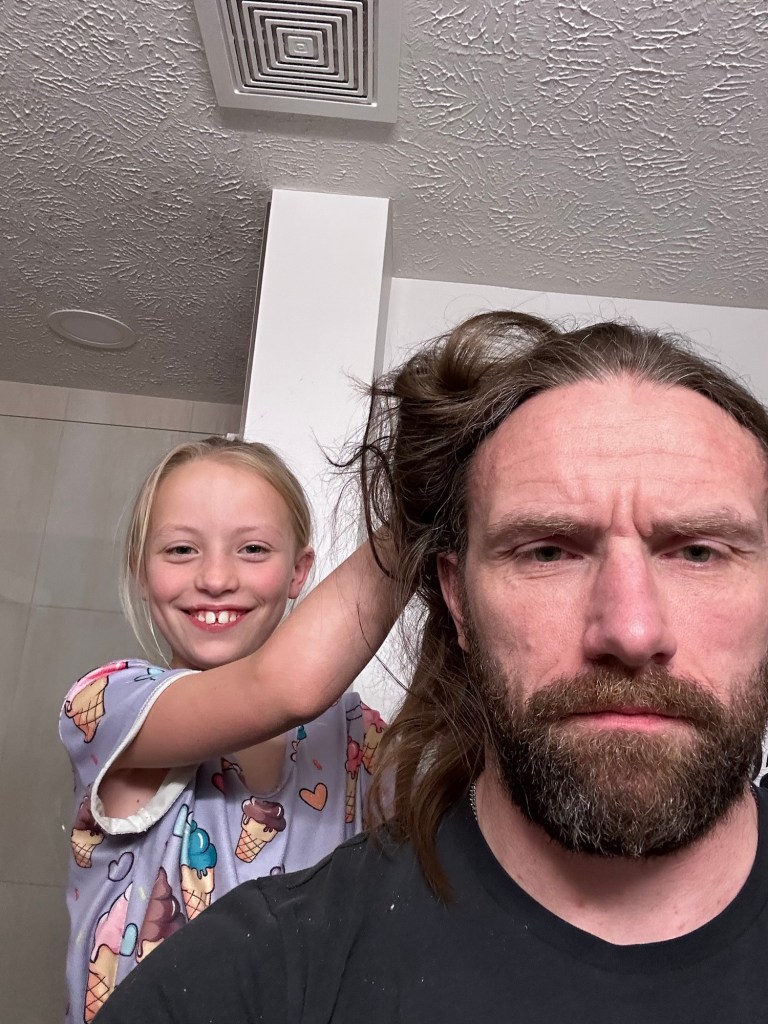
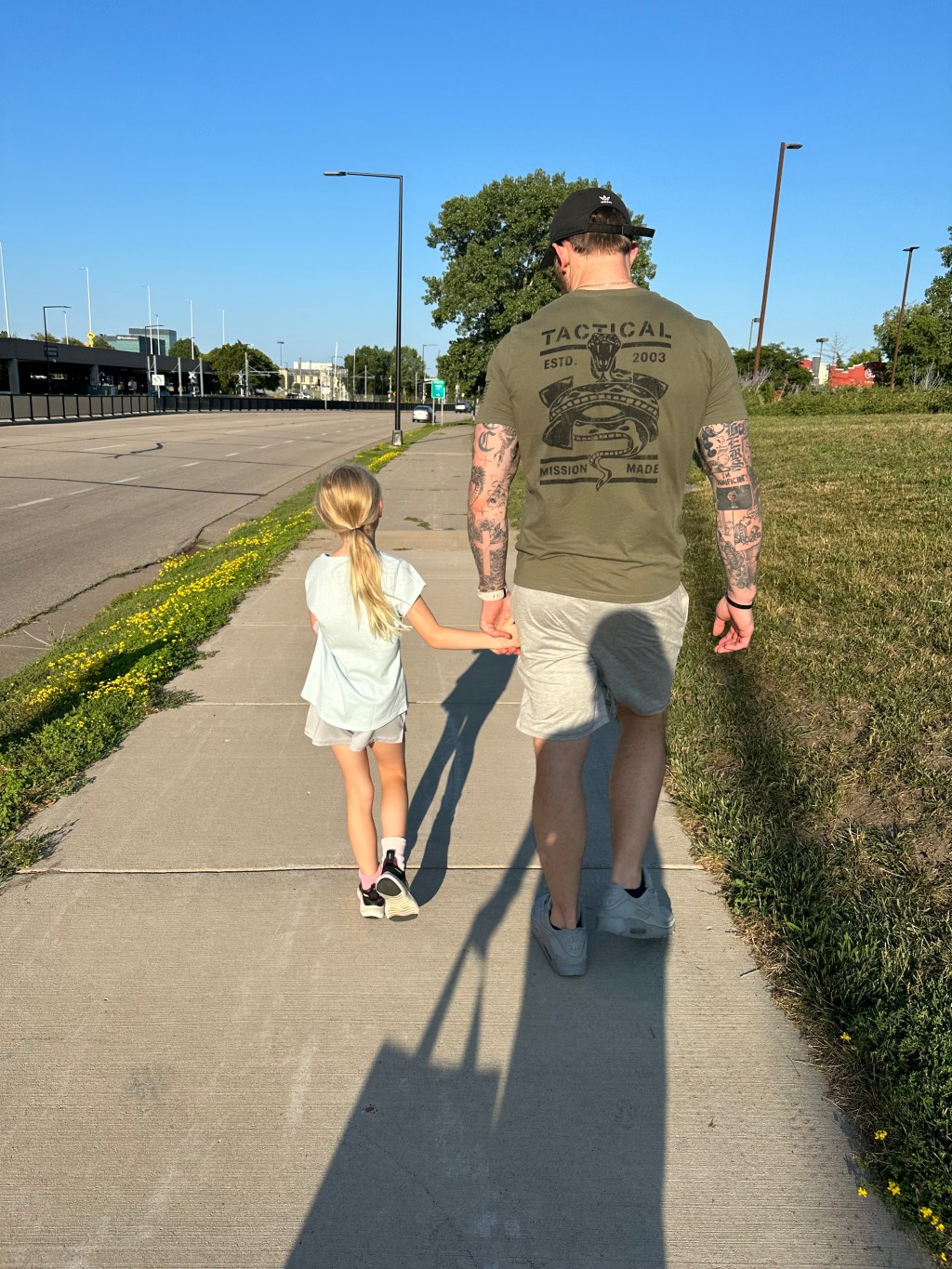
    A pic of me doing anything other than watching the news…..maybe she’ll braid it.
  • The Chalk Line

    The Chalk Line

    Elliot, a tall, slender man wearing a large untucked shirt splattered with various mediums of materials sat hunched over his canvas. In his shirt pocket, the box of cigarettes rests on the chest going in and out, deep breaths. His fingers smudged with oil paints digs into the pack, fumbling in the box spreading a dark oil over the bright white filters ends.

    His art never seemed to land quite right.

    The air in his studio was thick with turpentine and frustration.

    Dozens of unfinished paintings leaned against the walls, each abandoned just shy of completion, their potential strangled by his relentless pursuit of perfection. He had spent weeks, months—sometimes even years—on a single piece, only to despise it in the end. Like his cigarettes, the weight of expectation pressed against his chest, also like the smokes, a suffocating reminder that his art no longer felt like creation but a battleground between ambition and failure.

    One afternoon, weary from the endless cycle of doubt and revision, Elliot stepped outside for air. The city bustled around him, indifferent to his turmoil. His feet moved without direction until he found himself at the park, where laughter and life carried through the crisp autumn air. There, just off the pathway, a child crouched, a piece of chalk clenched in his tiny fist, his face scrunched in concentration.

    Elliot watched as the boy’s hand glided across the pavement, sweeping blues and yellows into the gray stone with an ease that seemed almost careless. A streak of orange, a swirl of pink—no hesitation, no erasures, just movement. The boy paused, squinting at his creation. For a moment, Elliot thought he recognized that familiar doubt, that paralysis of knowing something could be better. But then, just as quickly, the boy dropped the chalk and sprang to his feet.

    Without a second glance at his work, he bolted across the park, following the unmistakable chime of an ice cream truck. Elliot stood there, stunned. He waited, half-expecting the boy to return, to kneel back down and tweak a line or blend a color more carefully. Minutes passed. The chalk rested where it had fallen, abandoned like the artwork itself.

    Curiosity got the best of him. He turned his gaze from the unfinished drawing and scanned the park, spotting the child sitting cross-legged on a bench, an ice cream cone clutched in his sticky fingers, laughing with a group of friends. Elliot hesitated for only a moment before approaching.

    Kneeling, he extended the chalk towards the boy. “Do you want to finish your drawing?”

    The child barely glanced up, licking a drip of melting vanilla from his hand. “It’s done.”

    Elliot blinked. He turned his head slightly, looking back at the pavement where the colors sprawled in wild, unapologetic shapes. He had expected an explanation—some reason, some justification. Instead, there was only certainty.

    It’s done.

    Those two words landed heavier than all the years of critiques, rejections, and self-imposed expectations. He had spent his whole life trying to make something perfect, something worth admiring, yet here was a child who created simply for the joy of it. And then, when the joy was over, he let it go.

    For the first time in years, Elliot felt something shift inside him. A loosening. A breath of relief.

    A week later, he started working part-time at a coffee shop. Not because he wanted to quit art, but because he wanted to make art without forcing it to pay his rent. He wanted to create without the suffocating fear of failure. And so he did. Some paintings he finished in a day. Others he never finished at all. And for the first time in his life, he was okay with that.

    Because sometimes, you don’t need to perfect something to make it worth creating. Sometimes, it’s done when you decide it is.

  • Oppression

    Oppression

    Words matter. When we qualify something as a word, you encompass the topic, concept, idea, into that word. Word’s have a meaning, but history shows us that this meaning or intention can change. A word like “oppression” is one of those words, much like “discrimination” or dare I say it, “slavery.” They are all concepts that even just reading can invoke some emotion.

    I chose oppression to write about because it’s a word I am hearing used more these days. People in America are being “oppressed” by a tyrant. People are being held back or somehow blocked from what they want. Which, at a relatable level, sucks to experience.

    What does oppression mean? “Prolonged, cruel or unjust treatment or control.”

    To experience any level of cruelty what does that do to a person? Break them? Make them angry and resistant to any sort of change? Does it make you scared, hopeless, depressed? Does the entire environment or anyone who seemingly doesn’t agree with you wholeheartedly become an adversary?

    Now, nobody can deny any other person’s experience. So, I don’t deny people feeling oppressed in their daily life either under this current presidency or any other time in life. I don’t deny that it can be debilitating to feel threatened, to feel that around the corner there are choices being made that will have an effect on you, your family, possible future generations.

    My question is, how do those who feel oppressed, but wanted change before, know if what is being done isn’t for a larger good later? Therefore, the “greater good” later may require a sacrifice now. How do we know that all of this won’t lead to something good, later? Is it because we feel the person or persons making the decisions aren’t trustworthy?

    According to historical accounts of the German SS troops in WWII in the book, Ordinary Men: Reserve Police Battalion 101 and the Final Solution in Poland, the choice to be a part of something or not, is still up to each individual. These men’s journal accounts depicted the failure to act according to what they believed to be good, in support of the Jews. Instead they slowly fell into heinous mass murder.

    If you want some peace, try an exercise: When you experience a narrative of something, write two or three alternative perspectives. Force yourself to see what potential good could come from the current narrative you are experiencing. Work at being someone who is willing to challenge their notions, if only to better understand, there is an alternative perspective to everything.

    Triggered responses occur when we experience something that is painful or threatening in some way, setting the body into a fight or flight. When a threat to you or your wellbeing occurs, of course you are going to get amped up, of course you are going to have thoughts influenced by the biological response of fight, or flight.

    For the fighters out there, is what you are choosing to fight for, real and worth the potential sacrifice you might accrue as a result of an emotional choice in response to a “threat?” For the keyboard warriors out there typing some pretty damaging rants about how angry they are, how wronged or oppressed they are, what is it specifically you are responding to?

    These are real questions by the way. Not challenges. Curiosity kills, I am familiar with burning my own hand to see if the pan is hot. I want to touch on this topic of oppression because people are hurting, but some of the reason for hurt isn’t because of things going on, but the overconsumption of media and fear being promoted as a result. Threat of harm to anything you care about, leads to a justified fear response.

    Our minds work too quick for us, and questions can help us slow down a bit and investigate things more thoroughly. What happens when people slow down to realize what exactly they are feeling and ask “what can I do about this, what can I control?” What happens when we live as people trying to do good instead of identifying as oppressed or wronged leading to our inability to care for others?

    If you are drowning in the water you aren’t going to look out at the side of the pool and care for some kid who dropped his ice cream cone. When fearful you can waste all of your productive energy to yell out into the abyss to be heard. Online is like that, a large abyss, a seemingly large stage, but very little impact, if not just white noise.

    Dave Chappelle did this skit about 9/11. In the skit he references the old MTV music video show TRL. In the skit he talked about the twin towers and how when they fell, TRL host Carson Daly gets on a call with the rapper Ja Rule (who was incredibly popular at the time). Chappell references the idiocracy of getting Ja Rules opinion on the twin towers falling.

    “What would Ja do?” Chappell screams from the stage indicating that when he finds himself in trouble and unsure of what to do, he is now going to reference Ja Rule and what his thoughts are on matters.

    When in a heightened state, nobody should probably hear what you have to say. If you feel oppressed because of the information you are taking in and you feel justified in your angry response and you choose to share that, what is that going to do for other people? In your own way, you too could be the oppressor or at least reveal that you have the potential to oppose others as well.

    If you think the president is mad and hatred fills his bones, then do you hate back? If you want opposition to hate or it’s actually going to require you to love and be open to others. Yes, political parties, that even means to each other. You want to overturn the shift in the country, then love on each other more

    If you say that is how people are submissive and fail to make change? I disagree. I think doing good for others in our daily life does change things radically.

    Imagine you walk down the street and see 12 smiling faces, do you not think there would be some subtle shift in perspective of the world? If you are looking at yelling faces all day or yelling yourself, then yeah, you probably do feel the world is out to get you.

    Also, do we not think that every other government that fell before America did not have the people rebel or disagree along the way? Even with all of that anger as a result of oppression all the other nations fell. But I want to read about a nation that worked at loving each other and see how they did. Did nobody watch the Grinch and see the Who’s come together even after all of their stuff was taken?

    Sadly its human nature to rise to power, turn corrupt, and then the people fall into a faithless, fear state and then the whole thing collapses. How about in the face of oppression we choose to love and share words of uplifting comments and give more, rather than telling random people how angry or threatened you are.

    I don’t know, maybe there’s something I am missing. After all, I am supposed to be the Christian, white, heterosexual, cis-male with tall stature and medium-level income that is told doesn’t get it. So, fair enough, but the question of what you CAN do in the face of oppression and how is it going to serve the good of others still stands.

  • The Subtle Art of Caring

    The Subtle Art of Caring

    I am fortunate to get to hear stories everyday. Sometimes I wonder how many people wonder if I still care or not?

    I would hope that my presentation is one that demonstrates care, but what if there’s something I am unaware of that comes across as uninterested in the other person?

    But yet, to try to seem like we care isn’t really caring. To actually care requires us to no longer try to depict caring, but to feel what the other person feels.

    But then, how do we find the space for care and compassion for other people around us when we may be struggling ourselves?

    I find that it’s not about our initial thoughts that determine if we care or not, but to care is more about noticing our habitual first thoughts and choosing to act based on what matters the most.

    As humans we are designed to be together in community. I would gamble on the idea that if you dig deep enough, you do care about community. Even if you focus on yourself to be praised by that community. A reason why self-established god status is because you believe it is good for people to praise you, just like you might think it’s good to praise yourself. No god is going to think it’s not good for the people to praise them.

    As a general rule, we desire good for one another. So, although short-sided and misguided, self-promotion can be an attempt to do good.

    But how can we care about people in the right way,?

    1. We were given two ears to hear and one mouth to speak. Yes, all you philosophers out there, people loooooove to get advice, but often listening can show you care so much more.
    2. You can improve your ability to acknowledge the thoughts and then checking the thoughts against what matters to you and then choosing what action aligns with who you want to be.
    3. You want to be good, then do good.

    Good then comes down to thinking if you were that person, what would you want/need in this situation. If you like to talk like I do, then I love it when I get someone to listen to me. I love it when even though the person might not fully get what I am talking about, they can see my passion and because they want me to feel cared for, they care about hearing me talk about my passion.

    These people I like to talk with, nod, acknowledge my ideas, ask questions, even propose an alternative perspective. The best people first try to see what I am saying before they impose their ideas.

    So, thinking about the people I have enjoyed talking to, I work to mimic these people. Because of my own selfish nature, I need models to show me what a listener does to show they care. And no, it’s not being fake to do this, but it’s to live as the person I want to be.

    Now, smiling and nodding along is great, but there is so much more to caring. And this is important:

    Within a healthy relationship, I also like when I am challenged. When questioned with intent to help me see something differently I am grateful for it. I mean, I am initially defensive in my head, but with time and practice I can see how feedback is exactly what I need. So, I also use the relationship and understanding I believe I have with people to share the same challenges or alternative perspective to them. All of this is under the umbrella of caring for people’s good and wellbeing.

    Although the long-term goals of other people may be different than what we want for them, in the short time together we can demonstrate care and compassion by listening. We can improve at removing the expectation that we have to fix or answer everyone.

    Remember, when caring for others, it’s not about you.

    From where I stand, if someone comes to you with a problem, it’s good to listen. After the conversation you might find that the initial “problem” they had wasn’t really the problem. People have a desire to be heard. So, if we do to others as we would like to have done to us, we don’t give advice, correct, or even reprimand (although there is a time and place for all of these things), listen first. Then, through caring and empathetic ears we can ask ourselves what sort of conversations do we like to have and who do we think of when we imagine absolute kindness and caring at it’s best within a conversation.

  • Personality Hires

    Personality Hires

    To some extent, people are who they are and to expect them to be someone else, or naturally change into this other “ideal” person isn’t just a waste of hope, but it may lead to crushing feelings of failure for the one whom you want to change.

    There we have it, accept people for who they are and stop trying to change them, right?

    You tell me. When was the last time you had a friend, relative, spouse, roomate, church member, klansman even that you gave feedback to and they took it and ran with it?

    You may expect the feedback to be taken like this:

    “Oh thank you…I never knew I was a jerk. In my forty years of life, I assumed it was everyone else’s problem. Now I know better and will be more approachable.”

    Sure, some of the good ones will notice of small asks such as “take out the garbage,” or “Get those reports done on time.” But more advanced techniques such as “being more empathetic” or “I want my spouse to WANT to do these things” may require a bit more understanding of the person you are talking to. And I know we all love the idea that all people are capable of the same possabilites, but we aren’t all meant to do all things.

    One of the worst things that can happen when meeting with people for a problem they are having is trying to convince them to change who they are.

    For example, I was recently on a daddy-daughter trip through the Mall of America, one of the biggest malls in the world. Stacked sky high full of shopping, amusement park rides, foods, toys, all the items a child dreams of. However, I noticed a few things.

    1. My daughter doesn’t like to be told what to do or even offered options more than the ones she has already considered- she told me this.
    2. I shouldn’t expect anything. From moment to moment, she likes one thing, but then likes another.- She even asked to eat sushi which I never thought would happen.
    3. When she asks for something and I tell her “no” (rare, but it does happen), she doesn’t respond to it. But more than that, she keeps asking. Not in an annoying way or just to manipulate, but because she gets fixated on it, like can’t stop thinking about it. Much like the stuffy we saw on day one was talked about for the next two days! “When are we going to get that stuffy?” The thought would hit her in the middle of swimming, or while at dinner. Just a loop, playing around and around.
    4. If you are not concrete with her, she will find the loophole. Even if you lay out the plan, she is a wordsmith with her ability to redefine the terms of what was said.- “you said “no” earlier, but does that still apply now? And were you meaning no forever or just today?”
    5. She loves talking to adults that respond back to her with useful information. She finds the typical questions of “hows school” odd and doesn’t care to think of an answer. “Good” she says to keep people off her back. But if interested you get her to tell you anything.
    6. She is….well, much like her mom and dad in so many ways that I am hit with reality over and over again how much I need to listen and not get ahead of myself or assume the worst.

    You see, we all have brains that are wired from genetics, through birth and raised in environments that later attend to certain things and not others. We all pick up different details and hold things in our minds in different ways. We were all made uniquely by God for a reason and therefore “limits” as people like to argue, against, aren’t condemning, but freeing to find what we have no business in and then can let go of.

    One theory on human development is that humans learn by association or better, relationships to something else. To understand a concept, or thing, you have to have something earlier experienced to help conceive the idea.

    For example, numbers. Numbers are nothing to a baby. But as the child learns the material world and its significance, she may realize that two of something is more than one. Eventually numbers represent meaning but then the meaning is later exchangeable. Thus, two chores are not greater than one chore…unless you like chores of course.

    My daughter, much like your employee, or aunt, uncle, mother, garbage man, pilot, coroner, they hold things, see things, interpret things in their own way. I am not a better parent to anyones kid because I am formed into being my child’s parent. But it has taken me a long time to better understand her as her own person to live this role as an earthly father for her to influence who she is going to be.

    How many times do we stop seeing people for who they really are, only to see them for how we hold them in our heads, no matter how faulty that is. We stop listening to our friends and family because we “know what they are going to say.” Or we stop looking at our wives, employees, coworkers because we fail to see them as people.

    Side note: Do you ever watch those movies with evil henchmen who just die in masses by the hero? I mean, those people were humans, with moms and dads, lives, hobbies, all of their details were just as important to them as yours are to you. And here we are, watching John Wick go through and lay them down by the dozens. Just saying, I wonder how those families are doing after our “hero” obliterates their loved ones.

    Think of the employee who doesn’t do quality work because they realize they can skip the hard parts and probably won’t get caught. For this person, experience has taught them that there is little value in the work itself and the end product is what is most important. If you place this employee on a performance improvement plan, it can temporarily reinforce the fact they are being watched, but that’s about it. We hope it will instill the work as a priority, but wouldn’t we also hope they knew that already, that as adults they have worked before and that whoever is paying you, we can safely assume, wants quality work?

    Old habits, or core personality traits, and core beliefs about what it means to work and value one has in work, not to mention inner feelings towards community or principle, integrity, deeper elements of quality work, their spiritual relationships, all determine what a person will do in work, long-term.

    Not to sound too much like a tyrant on a Disney movie who says this person can’t do this, or can’t do that, the truth is, some people can’t do what is required to stay the partner or employee needed in the relationship. Not that one isn’t good for anyone or any job, but that this current situation, with their personality, won’t work out.

    Admitting limits isn’t a bad thing, but a peaceful acceptance that you are made for some things and not for others. You aren’t made for everything and sometimes a job will serve mercy and let you go so you don’t have to keep trying to be someone you aren’t. The key from any situation is to accept it for what it is and use the opportunity to figure out what your strengths are and where you can best leverage these strengths.

    Maturity, new information, new situations, encouragement or discouragement, all things can change a person’s perspective, but the change will still be from the person doing it, and will only change if the person sees some value in the change. You can’t make someone care about something, you can only show them and let them decide to care or not.

    So, what’s wrong with a personality hire? As someone who is personable, I find it helpful to work with people who fit more so than someone who might have a better resume, but isn’t willing to change or learn to the human beings around them.

    What’s worse than a jerk who is intentionally mean? Someone who is a jerk, doesn’t know it, doesn’t accept feedback about it, and justifies their mood and approach based on the wrong that has been done to them.

    If you are looking for an employee or partner, from where I stand, I think it is the most critical to find someone who is willing to take feedback and respect boundaries of others and work demands. Otherwise, you’ll be fighting an uphill battle to someone who is the way they are and will be whether or not they get on a performance plan, an ultimatum, or simply just get ignored by people that don’t want to be around them.

    In summary, sometimes your problems in life are you, not them. Take the feedback, meditate on it, ask yourself what matters to you and stop trying to cover inadequacies, but own them as equal parts of yourself.

  • Enough Rope?

    Give someone enough space to let them fail

    or crumble

    or self-destruct

    or….figure themselves out.

    “Let em cook”- Me (I say that)

    If you struggle with confidence, then listen up. Confidence is not found in “doing better” but found in acceptance.

    Take a nervous mom. Now, nervous mom can’t watch child fail. Nervous mom runs in and helps. Nervous mom is nervous and so she doesn’t have the time or patience to hold their child accountable or encourage them to ask for things. Nervous mom just does things for the child because “it’s easier for her to do it herself.”

    In short, nervous mom fails to provide what the child needs, which is the space for the child to figure themselves out. See, nervous mom has nervous thoughts and these thoughts overwhelm her. Nervous thoughts fuel nervousness.

    So, to all the nervous moms, dads, future parents, children of nervous parents, we can combat this with….

    Self-acceptance.

    Even stepping outside of the strictly psychological and into the deeper foundations of what it means to be a thinking human, is to notice our souls encompass our bodies. Our bodies are organs and flesh, upheld and driven by a soul. To a nervous person, the soul can hardened over time and thus reliance on the body’s sensations takes over.

    See, the flesh is weak, the soul and spirit are strong. The flesh tears, the organs fail, the brain contains ego that is scared of people and the challenges they propose to the sense of self the ego has formed. But the Soul, that is something else, something that sees the world through a God-dependent and therefore most full perspective.

    Even if you don’t believe in God, but you struggle with confidence, you still benefit from pretending to believe. Yes, even acting as an all-sovereign being made you and everything around you puts things in a proper perspective. Get out of your own head for a while and choose to view yourself through a different lens.

    Christians (those who claim to know God as God and therefore Christ as salvation for our eternal souls and ideal model of life) we should not be nervous.

    Unless…

    we don’t really believe what we say….

    we want to stay in charge and rely on the failing body to choose for us by way of “feelings.”

    we are warped in our thinking, thus say we have faith but act on reliance of other thing more.

    No matter who you are, it is confidence in the whole self that has to occur for you to be you. Then you can go into any situation unworried because you have this core that will not be shaken. For non-believers, you can hold to a core sense of values to stay consistent in any situation. For Christians, your soul is dependent not on the body, but God and His Promises.

    Remember: “I will never leave you nor forsake you.” Those sorts of promises.

    Back to the space: Nervousness/anxiety/insecurity/lack of self confidence etc. do not allow room for someone, even yourself, to “figure it out.” You need the faith that what will be, will be. Who you are is who you are. If you don’t like who you are, that’s furthest from self acceptance. You need to understand that you can’t hate yourself or deny parts of yourself and progress into a peaceful and successful life.

    So, parents, give the kid space to fail and figure some things out. Adults and children otherwise, give yourself the space to feel what you’re feeling and experience what it’s like to cope with that feeling.

    Once you know that you CAN tolerate feelings and emotions that otherwise trouble you or cause you to overreact, you also know you don’t have to control or stop others from learning that they too can tolerate and even get more creative in their problem solving.

    So, in conclusion and from where I stand, it is better to be given space to fail and then learn from or about that failure than it is to indulge the nervousness and what it tells you to do to be “Safe.”