Tag: mental health

  • Epiphany at 11:53 PM

    Epiphany at 11:53 PM

    It was probably my third extra spoonful of the creamy natural peanut butter at 11:53 PM that pushed me over the edge.

    I didn’t feel good at that point.

    Photo by Karola G on Pexels.com

    It may have been the packed caloric intake within a few brief moments of shoveling in spoonfuls of the creamy/grainy goodness combined with the last bit of Diet Pepsi that zoomed me past my comfort zone. It may have been the fan blowing on my feet thereafter causing me to be an uncomfortable temperature.

    Whatever it was, the conditions were ripe for, you guessed it, a late-night critical thinking session.

    This particular one wasn’t anything special, simply a theological debate in my head about sin, what it means to live, and what in my life needs to change that is holding me back from more.

    I don’t necessarily want “more” of any one thing, specifically. I want more space in my stomach for more peanut butter probably. I wanted smaller spoons that I count up when eating the heavenly legume mixture, sure.

    I know that it was here, chilly, uncomfortable, in bed where it hit me.

    “It’s not about me.”

    So, like any rational and uncomfortable person would do, I went to my office to write a blog post about it.

    This idea was more than just, “not about me” in the sense of doing good for others. But literally, at the deepest and purest place, my desire to do good isn’t about the version of myself that thinks it needs to not be about me. But from the view of God himself, the me he sees and knows, knows that for life to be full, for things to workout at the highest level, I need to give up the focus of my life being on my life and to seek Him.

    So, there it is. A verse I have heard a thousand times, now hitting my vulnerable and sleepy self like a ton of bricks. Like a release from my own body, like the Hulk being released from Bruce Banner’s body in the Avengers: End Game.

    For a brief second, I saw myself outside of myself and sat with the words of life. I saw my body lying there, thinking about myself, what I was going to do the next day, what sins I have committed the day before, what I need to do better on. I saw me thinking about me and felt pity for the guy I saw because of how off the mark he was here.

    Why would I get sad about losing my life if in fact, it has always been true that to find one’s best and only life is to give it up?

    I briefly thought of the commercials and movies I watched growing up. You know, during the good ol’ 90’s, which depicted a life best lived in scenes. One scene in particular was in the movie Father of the Bride.

    In the scene I recall from time to time (for no reason at all) has Steve Martin talking to his about-to-bed-wed daughter outside and I think it starts to snow. I think as a father that would be a really pivotal moment, one that I recall frozen in time. However, then I realized the movie was put out in….1991!

    1991! Are you serious?

    That means that in that scene, even if it was a real person, which is safe to assume some father at that time was going through it, and that here in 2025, that movie is 34 years old. That means, the already aged father of a 20-something getting married is now probably seeing his grandkids getting married and having children. (Also it means that Steve Martin does not age, he’s been an old man since he was born.)

    The scenes of my own life will soon be in the past and life will continue on, thus removing any significant moment I hold now to eventually be nothing because of my own passing and then my child’s passing, and her kids passing etc.

    We all age, move forward. Governments grow and fall. Things come and go. There is a season for this and a season for that. Nothing in this world lasts very long anymore, not to mention, lasts forever. Not even the most significant legacies. Warren Buffet’s empire will be gone in a blink of an eye meanwhile there is some sea turtle out there who saw it all come and go.

    So then, what stops me from falling into the abyss of nothingness? It’s that none of this, none of the world, none of the plans and outcomes of God’s plan found in man is about my life as MY life. But for HIS plan and intended outcome, the only true and real thing that will last.

    Yes, our lives have deep and eternal meaning. Yes, it serves us well to live “good” lives and to honor others as ourselves and serve and be of good cheer and be grateful for the moment. Yes a man who is blessed can go ahead and enjoy his blessings. However, life isn’t about these moments as the main plot point. One doesn’t live “good” for it’s own sake or for the pleasure of the man alone, but one lives “good” because he knows what is true and that what is true is from the authority on truth alone.

    Christ says He is the way, the truth, and the life (John 14:6). If this is to be true, then those who abide, turn to, trust in, apply his teachings, will have a “good” life as a result.

    I am not asking you to do anything here. Just sharing the thought that when you meditate on life from time to time, realizing that all of what there is now fading, shouldn’t cause massive panic or regret, even sadness, but can bring joy. Joy can be found in the reality that all things pass. All things except the Word, the Word that was brought to life. The Word manifested in Christ who came and walked this planet.

    Jesus. A real man. A real God. A relational God who is choosing to share with His people the truth that to find your life is outside of the you who finds it. But is only found when you come to the conclusion that your life isn’t about you, but Him.

    From here, truth can spread into decisions and perspectives that can alter decisions. You might find that you can let things go. You might find that what scripture says to do-to think of others as yourself as one thing, will become a natural process as you now think less of your own satisfaction as the ultimate outcome and see your life now found in Christ who brought redemption from the dark thoughts of this world alone- the thoughts that are riddled with fear, greed, lust, gluttony (which with peanut butter and my overindulgence demonstrated why we should NOT do that).

    When people talk about Christianity and what a Christian should and should not be doing, it’s not about us choosing from the place of us, the us that believed in the world as the point, but when we change our viewpoint, the things a Christian, or believer in Christ SHOULD do become more natural.

    We are natural creatures meaning we live our nature just like a dog lives theirs. What that nature is starts with how one views their life, which Christ reminds us is only truly found when someone gives up their life as their own and as a result, lives as Christ tells us in the Gospels.

    Now the passing of the peanut butter provides relief for the the me that chose to eat too much. The chilly air is no longer dominating my sensations (because I am in my office for one thing). But the negative sensations of my life are passed and I can feel a temporary relief. All the while knowing that there will be more discomfort right around the corner.

    It doesn’t really matter though, because if my life isn’t found as my life, then I can only find true relief in the Scriptures that indicate what vantage point one must truly see to live the best life.

    And it isn’t at the bottom of a 16 oz Smuckers Natural Peanut butter jar.
  • Most Fascinating Thing This Week (trust me, it’s helpful too)

    Most Fascinating Thing This Week (trust me, it’s helpful too)

    There’s a ton of really Un-fascinating stuff happening in the world right now. (Yes, with a capital “U”.) So I thought, let’s talk about one thing that’s actually fascinating (and maybe useful). Here are two that I chose from to discuss today.

    1. The idea of “ego” has become the go-to villain in the self-help genera of life. But spoiler alert: it’s not the bad guy.


    2. About 12% of all children in the world (yes, all children) have been sexually exploited in some way. Brutal fact.

    https://www.unsw.edu.au/newsroom/news/2024/05/more-than-300-million-child-victims-of-online-sexual-abuse-globally-report?utm_source=chatgpt.com

    Since the second is horrifying, soul-crushing, and entirely worthy of major spotlight, let’s put our focus on the first for now.


    So, about ego — no, it’s not the devil hiding behind your sofa.

    What we’ll call little e (yes, I’m being cute): this little guy sits at the center of the circle of “you.”

    Picture the inner you — the one that knows you’re skimming the surface, the one that whispers “I’m faking it” or “I don’t quite measure up”. That’s little e. That’s your self-barometer, your anchor, your sense-of-self storehouse.

    When your little e is solid and established, life runs smoother. You hear a story, you filter it through yourself, you respond (or not) from that place. But when little e is shaky, missing, or more “void” than “voice”? Enter chaos as the ultimate distraction.


    What it looks like when little e is missing:

    Imagine standing at the edge of a volcano. Or overlooking a cliff. Terrifying.

    Now imagine that emptiness — the “center” of your existence — is like that: a gaping, empty void. Scary enough, people would rather live outside themselves than face that emptiness. If you don’t have a strong internal “you” (little e, your ego in the healthy sense), you’ll end up living in relation to the outside world instead of from the inside.

    And what happens? Drama. Pure, nonsensical chaos. Because your little e can’t ground you, so you bounce around in the drama. And the “drama” here has no purpose other than to exist for it’s own sake.


    That’s where the classic drama show starts: Karpman Drama Triangle

    Yep — the Victim-Rescuer-Persecutor triangle.

    https://upload.wikimedia.org/wikipedia/commons/9/98/Karpman_Triangle.png

    photo credit:commons.wikimedia Karpman Triangle.png – Wikimedia Commons

    Here’s the quick version:

    • Victim says: “Poor me, woe is my life.”
    • Rescuer says: “Let me fix you, you poor thing.”
    • Persecutor says: “It’s your fault. I told you so.”

    The sick twist: people flip between these roles. Victim becomes Persecutor. Rescuer becomes Victim. It’s all a game of unconscious pay-offs. Meanwhile, nothing meaningful changes.

    (And here’s an advanced idea for those who get stuck in problem-solving: someone who places you in their drama will report a rational problem, “you didn’t do this.” A problem solver will try to solve or explain, but to no avail. Why? Well, because that would satisfy the drama and force someone back to their empty, unsettled self aka little e.)


    Why we keep doing this

    Because when your little e is weak or missing, you can’t face the inside. So you stay in the outside world: the social drama, the stories, the “who’s out to get me,” the hero-rescuer missions. Because those are easier than the void.

    And yes: if you’re always saving someone, or always being saved, or always blaming/being blamed — guess what? You’re probably knee-deep in the drama triangle, either as participant or audience.


    So what to do? (Besides rolling your eyes at people in drama)

    • Notice your pattern. Are you always the Victim? The Rescuer? The Persecutor?
    • Begin to build/strengthen little e: your internal sense of self. Hobbies, interests, commitments that are yours. Not just roles you play for others.
    • When someone else is in the drama loop: don’t become the hero-rescuer by default. Ask: What do you want? What can you do?
    • If you’re exhausted, unhappy, distant — and drama keeps showing up like an unwanted guest: maybe do the work. With someone (see: “good therapist”).

    From where I stand, that was a fascinating thing for the week.

  • The Cleverness of Christ.

    The Cleverness of Christ.

    Remember those classic 90s family sitcoms? Or maybe those gritty action movies with hyper-masculine heroes who never flinched no matter how large the explosion was behind them? There was always that one move—the classic power shift. The underdog, usually quiet and unassuming, suddenly reveals they were holding all the cards the whole time.

    Personal opinion here: The increased use of CGI and overall special effects has turned what made some of our heros significant- wit, cunning, cleverness, and problem solving, into whoever can sustain the most explosions.

    The real genius move goes like this:
    You ask questions. Not aggressively—just calm, curious, almost Socratic. You act like you’re trying to understand. And in doing so, you get the other person to reveal the truth themselves.

    Picture this: a well-dressed (why someone would wear khakis on a Saturday is beyond me) parent on a quiet Saturday afternoon walks into their daughter’s room- Full House vibes here, total Danny Tanner.
    “Hey Becky, you wouldn’t happen to have an treat I could have, would you?”
    Becky lights up. “Yeah, I did, Dad! I have a few in my drawer!”

    Boom. The power shift.
    In that moment, both parties know what just happened. The parent wasn’t asking out of curiosity—they knew. And Becky just confessed without even realizing it. No yelling, no accusations—just pure revelation. The moment becomes a gentle but firm teaching experience.

    This is a classic human dynamic, one we see in everything from Mr. Rogers to Die Hard.
    But guess who did it first?
    Jesus.

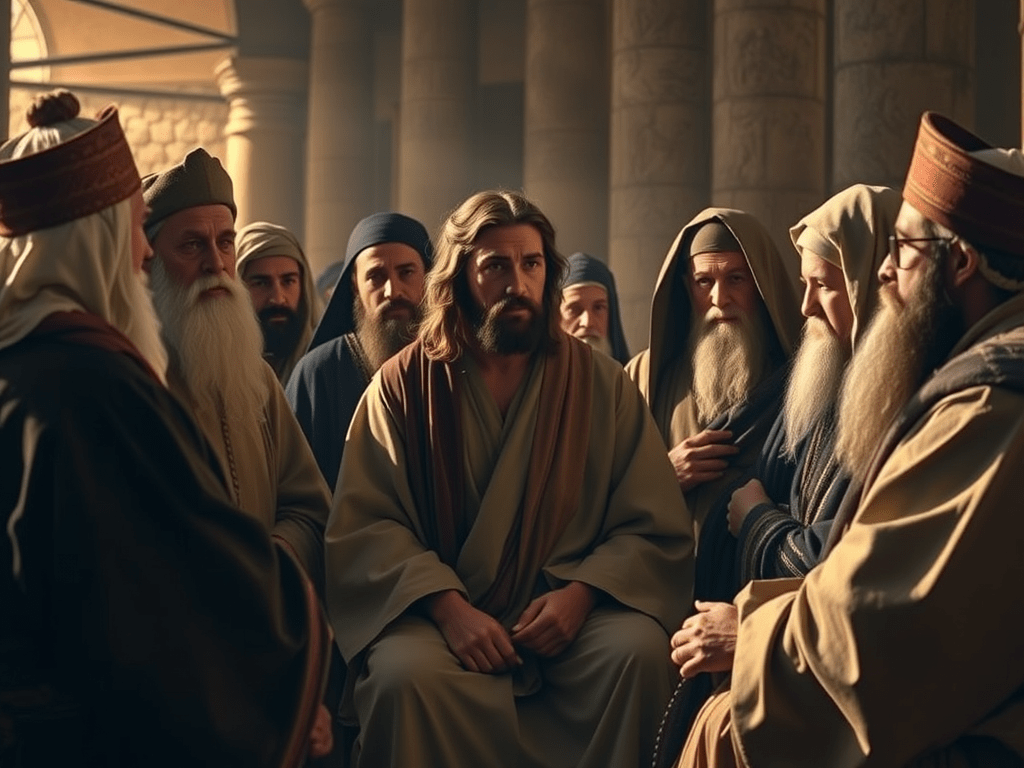
    In Luke 20:20–26, some legal experts and religious leaders try to trap Jesus in a political snare. They send undercover agents to ask him whether or not Jews should pay taxes to Caesar. It’s a setup:

    • If Jesus says “pay the tax,” he’s a traitor to his people, bowing to Rome and its idolatrous coins.
    • If he says “don’t pay,” he’s inciting rebellion—grounds for arrest.

    It’s a no-win situation.
    Or it would be, for anyone but Jesus.

    Instead of taking the bait, Jesus asks a simple question:
    “Show me a denarius.”
    And just like that—power shift.

    The moment they pull out the coin, everything unravels. The denarius had Caesar’s image on it, along with words honoring him like a god. By holding that coin, these supposed defenders of Jewish purity exposed their own allegiance to Rome. They revealed more than they intended, and Jesus didn’t have to lift a finger.

    He follows up with the famous line:
    “Give to Caesar what is Caesar’s, and to God what is God’s.”

    In modern terms, you could have heard the mic drop. If posted on reels, the crowd would have hissed and booed at the undercover men. The caption would have read something like: “Simple Carpenter Unravels the Whole Religious Hierarchy With One Phrase.”

    This wasn’t just a clever answer. It was a moment of divine judo—using the momentum of their trap to reveal them. No shouting. No violence. Just wisdom, presence, and peace.

    Jesus shows us what it looks like to be powerful without posturing.
    To hold truth without needing to worry. To walk the path of righteousness, not for show, but because it is the only path that doesn’t end in destruction.

    Remember the line, “If you have faith the size of a mustard seed you tell this mountain to go into the ocean and it will.” (If you don’t it’s here: Mat. 17:20, Luke 17:6) Well, this is the Faith Christ has, the sort of faith that He was teaching about-an uninhibited connection with the creator overseer and holder of all things. So of course, if you are Jesus here, you know what to do and know despite all other human attempts, the perfect way to execute in any situation.

    Whether or not you believe Jesus was God (I do), you have to admit: that kind of clarity is God-like. It reflects something deeper—Genesis 1:27 tells us we’re made in the image of God. That means we carry the potential to walk through life with the same quiet strength, the same clear eyes, the same wise confidence.

    So take that with you.
    You never know when a coin, a calm question, or a little Christlike composure might just save the day.

  • A bit Screwy: What Screwtape Letters reveals about ourselves and what we want to deny most of all.

    I’ve been on a bit of a C.S. Lewis kick lately, and I’d say “bear with me,” but there’s no need to merely bear with Lewis.

    Yes, I am indebted to his works—as they opened the door to forming a theology that is anything but stale or useless. I’m not a “Christian” alone, nor would I consider an introduction to me as “religious.” Those terms don’t capture the depth of a relationship with the Creator. Instead, I like to say that I’m a believer—but even that feels like saying I saw the sun today. I believe in many things, including the energy that flows through the world and that animals and plants have more purpose than we typically assign them. But I wouldn’t say I “believe” in trees or nature—it’s so obvious they exist that the term feels almost beneath the truth.

    No, I consider myself a child of God, reborn from a previous fallen state by the grace of God and the Spirit’s work in my life—allowing me to see truth apart from the everyday mentality of the world.

    This brings me to a fun little read by Mr. Lewis: The Screwtape Letters. I’m writing about this work because it reveals how easy it can be to lose your soul—and how the smallest, everyday choices quietly contribute to that loss.

    Sure, no one wants to lose their very essence—the thing that makes them them—but as fallen creatures of God, I think we ought to know just how insidious and crafty Satan’s minions are in their attempt to feast on souls.

    Now, a scholar could give you far more than I can, but I’ll do my best.

    My dearest audience,

    You know that little comment in the back of your mind—the one that lingers when you talk to that loved one? It judges what they do while preserving your behavior in context. That little comment of resentment may not be so little after all. It may be the seed of hatred, growing over years into full-grown disdain for all humans—including the One who made such detestable creatures.

    But surely you are not one of them. You’re just telling people the truth. Setting boundaries. Clearing your chest. Yes, the demons love it when you hold on to what makes you better than everyone else. When it’s always someone else’s fault, or someone else’s lack of judgment wounding you. Especially when you justify your snarky response as being “within context,” while the other person is judged at face value.

    Yes, they are hurting you, aren’t they? Making your life miserable. They need to be rebuked. After all, we are in total charge of our environments, aren’t we? Some of us already act like gods.

    Of course, no one says this stuff out loud. That would be ridiculous. We’re not bad people—we’re just misunderstood. We don’t need to change, just correct everyone to be more like us. On our noblest days, we may admit to certain faults—but never the ones we hold others accountable for.

    The other day, I saw a man walking, wearing a T-shirt that read: “Today’s good time is brought to you by WEED.” Well, certainly he was wrong. I stared at him from afar because of it. I even constructed a narrative in my head, depicting him as someone more worthy of disdain.

    I might as well have joined the demons at a local bar and dined with them on my own flesh, for what I chose to do with my mind—investing in thoughts that lead to bitterness and judgment. I could’ve driven my vehicle off a bridge and been better for it than to sit afar, condoning myself while casting a can-you-believe-this look at anyone who’d make eye contact.

    I’ve read the attempts of demons to capture souls, and I must agree with Mr. Lewis—Satan doesn’t want us to think too hard about the state of our soul, or to speak the thoughts in our head out loud. He wants them locked up, hidden, so we can keep convincing ourselves that we’re good people. Maybe even good enough. But never the bad ones. Surely not.

    Nobody wants to be a bad person, do they?

    Stay on guard. Stay bitter. Get yours at all costs.

    There’s your one-way ticket to losing your soul—giving it up to the world, living for dying things, and being only as good as your last success.

    Yes, people will leave you. And you’ll justify it, saying they didn’t “get” you.

    Stay in hiding. Satan loves hiding. He also loves shame. And ego. And just about any activity that keeps you from facing this simple reality: God loves you and wants you back.

    The Law—the commandments—can be summarized with two phrases: Love the Lord your God, and then love your neighbor as yourself. These two things lead to a fruitful life.

    So, shall we heed these words during our brief time here? Shall we trust they are the remedy for the chronic ailment called sin and all its effects?

    Or, like the flesh described in Screwtape Makes a Toast, will we become rather dull and flavorless meat—too passive one way or the other to be of value to the God who made us… or even to the demons who’d feast on us?

    Yours in sincerity,

    Uncle Meier

  • To Serve is To Live

    What’s the Point? (No, Seriously. What Is the Point?)

    At some point, we’ve all stood in the shower, stared off into the void (or the shampoo bottle), and asked the big question:
    “What’s the point of all this?”

    Like, really. What’s the point of working? Of meal prepping chicken and rice like we’re training for the Olympics when the only race we’re running is to beat traffic? What’s the point of going to the gym, squeezing into shirts that are a little too tight (okay, maybe that’s just me), and checking credit scores like its the weather?

    Asking “what’s the point?” is not a crisis—it’s actually a solid philosophical question, right up there with “Is cereal a form of soup?” and “Do dogs like me as much as I think they do?”

    But seriously—what happens after you reach the goals?
    You made the money. Lost the weight. Landed the promotion that requires 60 hours a week… which now requires 70 to maintain (and a personal assistant, a neck brace, and maybe a therapist-I know a good one). You bought the car. Paid off the student loans. Traveled to Italy and ate pasta that made those tight shirts even tighter in a different way. You’ve done The Things.

    And then what?

    At 25, I had this little existential meltdown (I think it’s called a quarter-life crisis). I realized I might not become a millionaire—despite my mother assuring me I could be anything I wanted to be, including the world-renowned biochemist I aspired to become after watching Outbreak at age nine. Thanks Dustin Hoffman.

    I mean, sure, buying those new shoes felt good. And yes, the compliments on the designer outfit were nice—until I realized I still felt kind of… empty. Not sad, not broken. Just unsettled.

    Now, some people find meaning in marathons, psychedelics, or finishing every episode of The Office (again). Others chase after this mysterious thing called “existential achievement” like it’s a Pokémon. And for many, the couch and a rerun of Seinfeld is more than enough—and hey, no shame if you’re still riding that DVD life.

    But if you’re one of the curious ones—the ones who can’t shake the “What’s the point?” question no matter how many productivity podcasts or oat milk lattes you consume—then maybe it’s time to stop asking what the point is, and start asking why you’re even here.

    Not to be dramatic, but… why do you exist? What was the reason for you being created in the first place?

    If you ask an atheist, they might say we’re just floating on a rock, existing until we don’t—nothing more, nothing less. Which is philosophically interesting but doesn’t help you get out of bed on a Monday. (No offense, atheists—but seriously, how do you guys do it?)

    Personally, I believe there’s a Creator—a higher Being who loves us into existence—and that gives me meaning. That awful Monday meeting? Purpose. That toddler tantrum in Target? Spiritual growth. That parking ticket? A lesson in patience.

    Because if love is real, and God is love, then you are loved—on purpose. Not randomly, not accidentally. And that changes everything.

    Achievements are fine. Financial freedom is lovely (at least I’ve heard that). But none of it will satisfy the soul. Not fully. Not for long.

    So maybe the real question isn’t “What’s the point?”
    It’s: “What am I here for?”
    And “How can I live the most valuable life with the time I’ve got?”

    If you start there, even the tight shirts start to make a little more sense.

  • Camping Theology and the Great Disconnect.

    Camping Theology and the Great Disconnect.

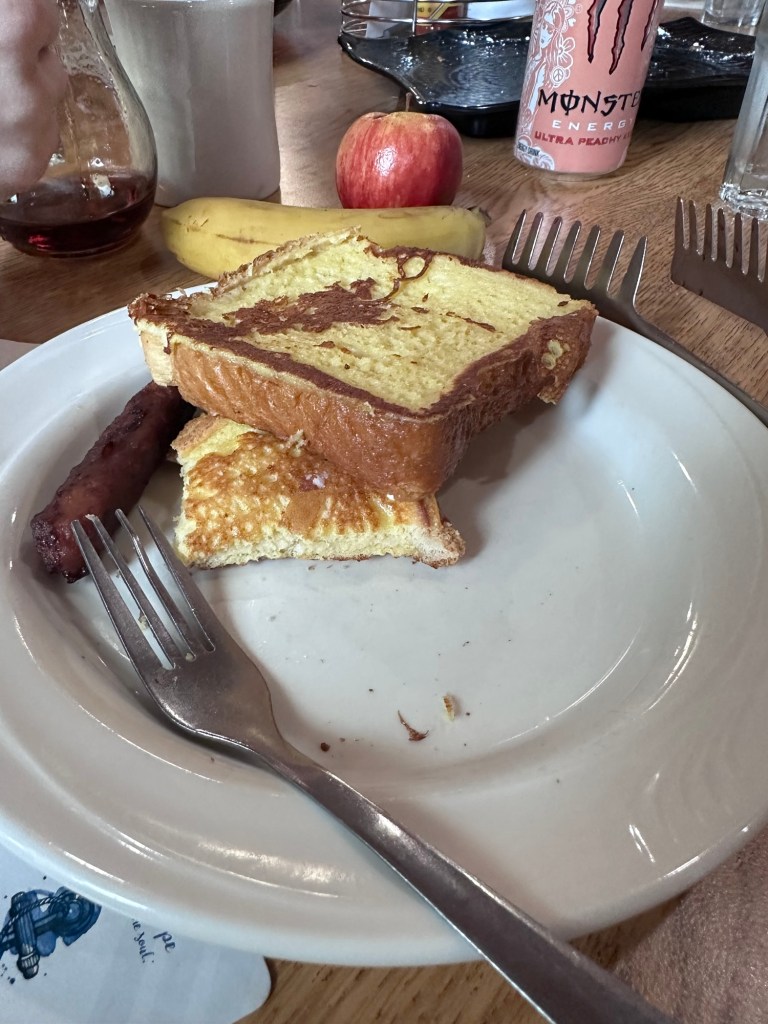
    A hearty breakfast before worship (God bless it).

    What is it about trees, open land, a pile of pancakes, a dining hall with a modern, cabin-esc vibe, basketball courts and highly weathered balls, not to forget, the ever-humbling Pickleball court that turns even the proud into the breathless… that makes it all feel so magical?

    No, this isn’t just any campsite. This is church camp.

    And yes—I’m 39 years old. I know. Church camp isn’t just for teens with underdeveloped frontal lobes. It’s for grown adults with student loans, aging knees, and deep questions about meaning, suffering, and why camp mattresses are still apparently made from recycled plastic cups.

    No. My foot was not over the line. (Photo Credit: Bre Gray- bregrayphotography.pixieset.com)

    At first glance, it’s a recipe you wouldn’t expect to nourish the soul: communal sleeping with nine other guys, unreasonably early mornings, and food so rich and hearty it feels like we’re dining with medieval royalty (minus the beheadings, plus a lot more cheese). And yet, somewhere between the 16-hour days, the constant change of sweaty clothes, and the silverware I didn’t have to wash, I remembered something.

    Every day had rhythm at camp: morning and evening worship services, time carved out for silence and scripture, group discussions about faith—where it’s lived, where it’s lost, and where we’re still fumbling in the dark. But it’s not just the programming. It’s what happens when we step outside the script of “real life” and into something slow, and never ending.

    At 39…my back starts to feel it.

    Be honest: our daily lives are designed to distract us from ourselves. We march through schedules, crush goals, pay off student loans (until the end of time), scroll endlessly, and quietly wonder, “Is this it?”

    But camp—the right kind of camp—brings you face to face with your own soul. You can’t outrun it out there. There’s nowhere to hide when you’re sitting around a well-crafted cabin table, under a star-pierced sky, holding a thermos of Minnesota’s finest tap, and realizing how long it’s been since you actually felt still.

    One of the biggest things I see as a therapist?

    People are disconnected from themselves.

    Not the version they present to the world. Not the curated personality or the productive employee or the “good” parent. I mean the real them. The one that’s still under there somewhere, buried beneath bills and burdens and the belief that if we just push hard enough, we’ll eventually feel okay.

    But here’s the catch:

    We don’t know why we do what we do.

    We think we know. We tell ourselves stories.

    But often, those stories aren’t true.

    That’s why reflection—real, sometimes uncomfortable reflection—is so important. Because if we don’t pause and reassess, we wake up one day bitter, cynical, and convinced that the best parts of life are behind us.

    Being with middle school through high school students this past week reminded me what it was like to be joyous and live in the moment. They had within them a camaraderie that we often don’t find in the routines of everyday life. These students had each other and they had, well, connection.

    Connection, especially the kind that touches the deepest part of our being, is what we were made for. Not just connection with people (though that’s crucial). But connection with God—the Creator who sees through all our layers and still longs to be close.

    And when we don’t connect with Him?

    We find substitute relationships:

    – With our careers

    – With approval

    – With achievement

    – With control

    But those things will fail us, sooner or later.

    They make terrible gods and even worse friends.

    Yet life isn’t shallow. Not at all. It’s deep and eternally significant. Every moment. Every choice. Every quiet ache.

    The tragedy is not that life lacks meaning, but that we rarely stop long enough to see how meaningful it actually is.

    And no, you don’t have to be at a camp with creaky bunks and bug spray in your hair to realign. You can pause for five minutes between Zoom calls, or in the carpool line, or right before you open another Microsoft Word doc, and simply ask:

    “What’s really going on in me right now?”

    “What do I want to be about today?”

    “God, are You near—and am I listening?”

    If you do that daily—even just for a week—you might be surprised. You might start to see your life with fresh eyes. You might remember that you are more than your resume, your obligations, or your debt-to-income ratio.

    Because here’s the truth:

    You can’t have a great marriage without effort.

    You can’t be a great athlete without training.

    And you can’t cultivate a soul without intentional time with the One who gave it to you.

    From where I stand, the greatest lack in most people’s lives is not time, not opportunity, not intelligence, or even love.

    It’s spiritual disconnection.

    From God. From truth. From themselves.

    But the good news?

    You can reconnect.

    Right now.

    No reservation needed.

    And maybe—just maybe—that’s where the real magic begins.

  • To be honest…

    Honestly? I sat down to write this with zero agenda. Nothing. My genius said, “Just start writing and see what happens.” Always a solid strategy.

    So here I am—two lines deep—and already staring at the blinking cursor like it’s judging me.

    Idea one: What happens when the worst thing in life happens?

    Nope. Too heavy. Not today.

    Okay okay, here’s one: What happens…

    Gross. That’s so vague it could be a free online article…oh.

    Wait—I’ve got it:

    I have absolutely no idea. That’s the idea.

    Yep. No one knows the answer. Not me, not you, not that podcast host with the perfect bookshelf background (which I have-less perfect however). Not your favorite fitness influencer, your mom Facebook group, your stylist, or that one guy at the gym who somehow always has advice for everything except leg day (and diet).

    Forgive my little neurodivergent detour here, but when we’re trying to solve problems we usually end up drowning in opinions, frameworks, TED Talks, and cold plunges. Everyone has a hack, and yet… nothing changes.

    So how the heck are we supposed to move forward and live a meaningful life if we don’t even know what “solved” looks like?

    Here’s a thought: maybe we need to zoom out. Like… way out. Maybe we stop looking just at our brains, or our culture, or even our bodies—and take a peek at that deep, mysterious, spiritual part of ourselves.

    Yep. One of those posts.

    Don’t roll your eyes just yet.

    Because every day, you’re solving problems—some big, some small, some that just involve whether or not you can justify buying another pair of kicks/drip. Behind all those decisions is something deeper—something that drives you, that gives your life meaning.

    Dallas Willard—brilliant theologian and philosopher—once said (and I’m paraphrasing here): “What your soul is connected to determines how well your soul is.”

    Translation: If your soul is tied to your job, your team winning the playoffs, your group chat, or your Sunday routine, then your soul is gonna ride the rollercoaster of those highs and lows. But if it’s rooted in something deeper—like, say, the Creator of the whole show—then there’s a steadiness, a sense of “home,” even when things get shaky.

    Yes, even you overzealous people forgetting to turn off the news every once in a while.

    So yeah. No clear answers. No five-step plan. Just a thought worth sitting with.

    And honestly? I think it’s worth it.

  • Is Fear Making You a Jerk?

    Spend the Ten Bucks, or Spiral Into Existential Dread?

    If someone handed you $10 right now, would you A) gleefully march into a coffee shop and upgrade your sad drip sort of life to a life-affirming double shot, sugar free caramel, heavy cream breve? Or B) stand in the middle of the sidewalk, paralyzed, wondering which of your potential dreams you’ll crush by spending that Hamilton? (Spoiler: It’s just ten bucks. Chill out.)

    This, oddly enough, mirrors a spiritual moment I had during a self-imposed “growth spurt” —the kind where you decide you’re going to get deep, and then immediately regret how deep you went. I can get obsessed sometimes.

    Enter Foxe’s Book of Martyrs. If you’re ever in the mood for a light read that’s actually the opposite of that — like, “ouch-my-soul” level dark — it’s perfect. It’s a collection of stories about early Christians who suffered unimaginable horrors. I used to say unimaginable, but now that I’ve read enough of it to crush any resolve for that week, I wish I couldn’t imagine them anymore. Thanks, John Foxe.

    Much like Christ — who was crucified by the Romans with PhDs in Torture Design — these stories are powerful, brutal, and historically necessary to be aware of. But here’s the thing: constantly marinating in the worst of humanity doesn’t actually help us become better humans. I mean, you don’t get joy by doomscrolling martyrdom, right? Or by seeing others great new thing and telling yourself you’re a loser because you don’t have the same.

    So here’s the twist: whether you’re a CEO, a stay-at-home parent, a single introvert with a dog named Dan, or someone who still doesn’t know how taxes work — life constantly hands us two roads. One leads forward. The other looks like it’s going forward… but turns out to be a really confusing cul-de-sac with a sign that says “Growth Stunted Here.”

    And while we love to say things like, “I just feel stuck,” the truth is, we’re all driving our own little emotional Teslas charged by what we truly desire in life: our mood, our mindset, the narrative we cling to like the cliffhanger of our favorite new show. Nobody’s totally out of control — not even your Aunt Jenny during election season.

    In reality: humans were made in God’s image, with the ability to choose. But instead of staying plugged in to God’s mind-blowing wisdom and presence, we veered off, choosing our own “brilliant” ideas. And surprise! That disconnect kicked off a multi-generational game of Operation: Fear edition. (Don’t step out of bounds, you’ll get buzzed).

    It’s no wonder we fixate on what’s wrong. The world practically dares us to. But being stuck in that pattern doesn’t mean we’re depressed. Sometimes, we’re just being… well, let’s say “chronically cranky.” Or as the street psychologists say: “negative assholes.” It’s a common diagnosis. No copay required. (Send $35 if you’d like though.)

    So the real question is: what are you focusing on today?

    Is it what you fear? What you lack? What you wish were different?

    Or do you believe — even just a little — that you have the power to shift your focus to the good? To be present, even if the present moment involves spilled coffee, a toddler tantrum, or a boss who thinks “urgent” is a personality trait?

    Because choosing to be present — to stop judging, stop spiraling, and just be — that’s the sweet spot. That’s where gratitude lives. That’s where your healthiest self starts waking up and saying, “Hey, this might be okay after all.” After all, life’s a journey, right?

    So, next time you have $10 — or a hard decision, or a tough day — ask yourself: am I spending it on growth, joy, presence… or renting space in Downsville?

    Choose wisely. And maybe still get the best latte of your life. You’ve earned it.

  • Size 15: A Journey

    Again…enjoy your sweet, sweet shoes you small-footed people. 😑

    Let us embark on a peculiar journey—quest, if you will—into the bizarre world of men’s shoes. For this story to be authentic, tis I who is the holder of the size 15.

    Yes, fifteen. A size that sounds less like footwear and more like those small “smart” cars in mid 2000s.

    I invite you, dear reader, to wander—into the labyrinth of online sneaker retailers: Nike, Adidas, New Balance, or whatever new age brand that was forged in the fires of Mount Hype last week. Choose your favorite Jordan, perhaps an Air Max 90 with a color scheme with just the right color palate it screams “you can’t get these!” and here in the sea of exclusivity: size 15? Sold out. Gone. Vanished like your motivation after eating a pack of ultimate stuffed Oreos.

    You might think, “Surely, this foot size would guarantee an overstock!” But no. It turns out that size 15 is a cruel paradox—rare enough to be inconvenient, yet common enough to be competitive. It’s like trying to find a left-handed coffee mug at a right-handed convention. They exist, but there are many people looking for the few that are around.

    Now, you may wonder, “Why on Earth should I care about this man’s odyssey?” Because (enter Forrest Gump accent): life is like a pair of shoes, my friend.

    Let me explain.

    Scarcity breeds value. Exclusivity inflates desirability. That same Jordan in a size 6? Might be on clearance next Tuesday. But a size 15? Full price and sold out in a minute. Maybe even resold for double. People camp out, not for warmth or camaraderie, but to clutch that elusive grail of rubber and laces. And suddenly—bam!—it’s not just a shoe, it’s a statement. A status symbol. A “flex.”

    This, friend, (we are friends now btw) … “Hello friend….Brother (Hulk Hogan voice) anyway…this “exclusivity” is what the sneaker world calls hype. And what we, in the world of hyper-fixation and compulsion might call… a trap.

    Because sometimes, what we want most isn’t actually what we want—it’s just what everyone else seems to want. Context is everything. That prized possession in one mindset? Utter trash in another. Like a prom tux at a Midwest wedding (jeans or cargo shorts only please) or a fork at a hotdog-serving venu—out of place, unnecessary, even ridiculous.

    So what if, just consider here, the thing you’re so obsessed with—the job, the relationship, the approval, the Yeezys—is only precious because of the mental lens you’re wearing right now? And what if, instead of focusing on doing less of the “bad” things, you simply added more of the good stuff—friends, purpose, vulnerability, laughter, a damn shrug the shoulders every once in awhile in the midst of stress 🤷🏻‍♀️🤷‍♀️?

    Maybe then, the cycle breaks on its own. Not through deprivation. But through distraction… by something better.

    Maybe your success isn’t about what “not to do,” but what to do.

    So next time size 15 is sold out, maybe take it as a reminder to think of me, or better the message (yes, the message): you don’t need that shoe. You need a new lens. And maybe take some time off and let little interferences go by saying “wow, look at those trees…just a blowing in the wind. How powerful those branches are to hold up to that.” Though we concluded on trees, we started with feet, my feet, and how through obscurity…we can find something useful, if we look for it.

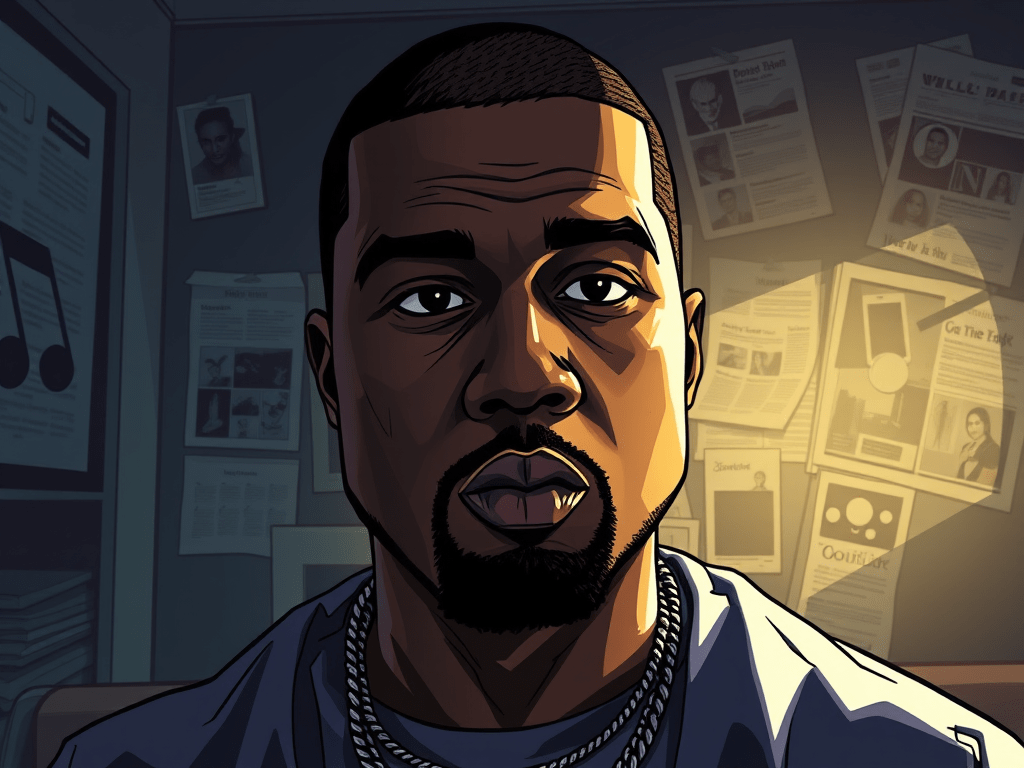
  • Ye: Loss. Brilliance.Faith.Trauma. and Yes-mental health

    Ye: Loss. Brilliance.Faith.Trauma. and Yes-mental health

    Genius, crazy, rich, antisemitic, controversial, chaos, egocentric, attention-seeking-These are all words that swirl around the name Kanye West. They’re also words that, if we’re being honest, have swirled around many of our names too, just without the a Kardashian and seven-part documentaries made about us.

    There’s something strangely egotistic in me to even have the urge I felt to even write this. Whether it’s a futile attempt to educate, or just an exercise in reflection, here I am, offering a few words on a person who seems to provoke something in nearly everyone. Ye makes it’s hard to look away.

    It was earlier this week—Monday and on to Tuesday—when news surfaced again about Ye. Or Kanye. Or Yeezy. You can read the article if you want to know the details. Personally I am still digesting the interview where he’s wearing a black White Supremest hood in a hotel room talking for 58 minutes about why he’s wearing the black hood in the first place. But that’s not really the point of this.

    What is the point?

    Maybe it’s this: despite all the controversy, all the confusion, this man keeps creating. Music. Fashion. Art. Controversy.

    And we keep buying it. After all, he didn’t get to be No.4 on the all time Hip Hop sales list by sucking at his craft. We keep listening. Some of us still remember the first time we heard Jesus Walks. For me, it was right after basic training in the summer of 2004. That song wasn’t just music—it was a a light in an otherwise dark era of music. Literally a light too, making one of his first singles be about Jesus, very light-bearing.

    But being good at a craft and rich doesn’t erase trauma. Creativity doesn’t cancel out pain. Nor does fame justify erratic behavior. But what happens when you start connecting the dots?

    What happens when we hear that childhood trauma shaped much of this man’s life—long before he had a platform to express it?

    What does that do to a boy, growing up and figuring out what it means to be a man?

    Kanye shared that he found magazines in his mom’s closet—magazines that shaped his understanding of sex, identity, and self-worth in ways that were far beyond his years. And long before the headlines, there was that little boy trying to make sense of what he saw, of all that he experienced.

    We all have experiences that shaped us, for better or worse. And here’s the kicker, we didn’t get to chose those experiences or decide how they affect us.

    So when we rush to label, to cancel, to condemn—what are we really doing? Are we holding someone accountable? Or are we just distancing ourselves from the parts of him that remind us of the parts we try to hide in ourselves?

    After all, isn’t pornography the bane of a young man’s existence these days? Are the adults now, failing to admit to themselves their own shaping of sex, relationships, what it means to be a man?

    Empathy is the bridge to forgiveness.
    Not because forgiveness means agreement. But because empathy allows us to see someone as someone—not as a headline, not as a cautionary tale, but as a human being formed by the sum total of his experiences.

    If you zoom in on Kanye West, you can isolate any number of choices, some of which are difficult to defend. But if someone zoomed in on your worst moment—your ugliest thought—what would they find?

    This isn’t a defense of bad behavior. It’s a reflection on how quick we are to misjudge when we don’t know the whole story.

    In C.S. Lewis’s The Great Divorce there is a man Len, a spirit who was a murderer in life, but now reconciled with God and is in Heaven. Another man, the Big Ghost believes he is a “good man” despite evidence that he was not. the Big Ghost character would be that of a man today, maybe you who demand’s recognition for being good, for doing right. Meanwhile that man, the character Big Ghost fails to repent and rejects heaven in the process. Yes, the murder remained in Heaven.

    Christ flipped the typical human narrative of what appears to be good may not be, and what appears to be distant or far from God may be the closest. Like Mr. West who has many faults, we too can choose to be the Big Ghost and cling to our own “goodness” and fail to relate to someone who is easy to categorize as a “bad” one.

    No person is defined by a single act—good or bad. If we believe otherwise, then we’re condemning ourselves every time we fail. We’re erasing nuance, context, and the messy truth that people are often doing the best they can with what they’ve got.

    To live with grace is to recognize that. It’s to understand that every decision is filtered through a complex web of history, beliefs, trauma, and identity. It’s not about excusing—but about seeing.

    And maybe that’s what Kanye, in all his chaotic truth, mirrors back to us. Maybe that’s why his story unnerves us. Because in his rawness, we’re forced to look at our own contradictions. Our own judgments. Our own worst parts. And if we’re honest, maybe they’re not as far from his as we’d like to believe.

    So the next time you’re tempted to judge—pause. Ask yourself this-is this about what they did, or what it stirred in me? Is this really about them—or is it about my own discomfort?

    Because the truth is, we all carry things that others wouldn’t understand. And we all hope—deep down—for grace when we least deserve it.