Tag: life

  • Epiphany at 11:53 PM

    Epiphany at 11:53 PM

    It was probably my third extra spoonful of the creamy natural peanut butter at 11:53 PM that pushed me over the edge.

    I didn’t feel good at that point.

    Photo by Karola G on Pexels.com

    It may have been the packed caloric intake within a few brief moments of shoveling in spoonfuls of the creamy/grainy goodness combined with the last bit of Diet Pepsi that zoomed me past my comfort zone. It may have been the fan blowing on my feet thereafter causing me to be an uncomfortable temperature.

    Whatever it was, the conditions were ripe for, you guessed it, a late-night critical thinking session.

    This particular one wasn’t anything special, simply a theological debate in my head about sin, what it means to live, and what in my life needs to change that is holding me back from more.

    I don’t necessarily want “more” of any one thing, specifically. I want more space in my stomach for more peanut butter probably. I wanted smaller spoons that I count up when eating the heavenly legume mixture, sure.

    I know that it was here, chilly, uncomfortable, in bed where it hit me.

    “It’s not about me.”

    So, like any rational and uncomfortable person would do, I went to my office to write a blog post about it.

    This idea was more than just, “not about me” in the sense of doing good for others. But literally, at the deepest and purest place, my desire to do good isn’t about the version of myself that thinks it needs to not be about me. But from the view of God himself, the me he sees and knows, knows that for life to be full, for things to workout at the highest level, I need to give up the focus of my life being on my life and to seek Him.

    So, there it is. A verse I have heard a thousand times, now hitting my vulnerable and sleepy self like a ton of bricks. Like a release from my own body, like the Hulk being released from Bruce Banner’s body in the Avengers: End Game.

    For a brief second, I saw myself outside of myself and sat with the words of life. I saw my body lying there, thinking about myself, what I was going to do the next day, what sins I have committed the day before, what I need to do better on. I saw me thinking about me and felt pity for the guy I saw because of how off the mark he was here.

    Why would I get sad about losing my life if in fact, it has always been true that to find one’s best and only life is to give it up?

    I briefly thought of the commercials and movies I watched growing up. You know, during the good ol’ 90’s, which depicted a life best lived in scenes. One scene in particular was in the movie Father of the Bride.

    In the scene I recall from time to time (for no reason at all) has Steve Martin talking to his about-to-bed-wed daughter outside and I think it starts to snow. I think as a father that would be a really pivotal moment, one that I recall frozen in time. However, then I realized the movie was put out in….1991!

    1991! Are you serious?

    That means that in that scene, even if it was a real person, which is safe to assume some father at that time was going through it, and that here in 2025, that movie is 34 years old. That means, the already aged father of a 20-something getting married is now probably seeing his grandkids getting married and having children. (Also it means that Steve Martin does not age, he’s been an old man since he was born.)

    The scenes of my own life will soon be in the past and life will continue on, thus removing any significant moment I hold now to eventually be nothing because of my own passing and then my child’s passing, and her kids passing etc.

    We all age, move forward. Governments grow and fall. Things come and go. There is a season for this and a season for that. Nothing in this world lasts very long anymore, not to mention, lasts forever. Not even the most significant legacies. Warren Buffet’s empire will be gone in a blink of an eye meanwhile there is some sea turtle out there who saw it all come and go.

    So then, what stops me from falling into the abyss of nothingness? It’s that none of this, none of the world, none of the plans and outcomes of God’s plan found in man is about my life as MY life. But for HIS plan and intended outcome, the only true and real thing that will last.

    Yes, our lives have deep and eternal meaning. Yes, it serves us well to live “good” lives and to honor others as ourselves and serve and be of good cheer and be grateful for the moment. Yes a man who is blessed can go ahead and enjoy his blessings. However, life isn’t about these moments as the main plot point. One doesn’t live “good” for it’s own sake or for the pleasure of the man alone, but one lives “good” because he knows what is true and that what is true is from the authority on truth alone.

    Christ says He is the way, the truth, and the life (John 14:6). If this is to be true, then those who abide, turn to, trust in, apply his teachings, will have a “good” life as a result.

    I am not asking you to do anything here. Just sharing the thought that when you meditate on life from time to time, realizing that all of what there is now fading, shouldn’t cause massive panic or regret, even sadness, but can bring joy. Joy can be found in the reality that all things pass. All things except the Word, the Word that was brought to life. The Word manifested in Christ who came and walked this planet.

    Jesus. A real man. A real God. A relational God who is choosing to share with His people the truth that to find your life is outside of the you who finds it. But is only found when you come to the conclusion that your life isn’t about you, but Him.

    From here, truth can spread into decisions and perspectives that can alter decisions. You might find that you can let things go. You might find that what scripture says to do-to think of others as yourself as one thing, will become a natural process as you now think less of your own satisfaction as the ultimate outcome and see your life now found in Christ who brought redemption from the dark thoughts of this world alone- the thoughts that are riddled with fear, greed, lust, gluttony (which with peanut butter and my overindulgence demonstrated why we should NOT do that).

    When people talk about Christianity and what a Christian should and should not be doing, it’s not about us choosing from the place of us, the us that believed in the world as the point, but when we change our viewpoint, the things a Christian, or believer in Christ SHOULD do become more natural.

    We are natural creatures meaning we live our nature just like a dog lives theirs. What that nature is starts with how one views their life, which Christ reminds us is only truly found when someone gives up their life as their own and as a result, lives as Christ tells us in the Gospels.

    Now the passing of the peanut butter provides relief for the the me that chose to eat too much. The chilly air is no longer dominating my sensations (because I am in my office for one thing). But the negative sensations of my life are passed and I can feel a temporary relief. All the while knowing that there will be more discomfort right around the corner.

    It doesn’t really matter though, because if my life isn’t found as my life, then I can only find true relief in the Scriptures that indicate what vantage point one must truly see to live the best life.

    And it isn’t at the bottom of a 16 oz Smuckers Natural Peanut butter jar.
  • Most Fascinating Thing This Week (trust me, it’s helpful too)

    Most Fascinating Thing This Week (trust me, it’s helpful too)

    There’s a ton of really Un-fascinating stuff happening in the world right now. (Yes, with a capital “U”.) So I thought, let’s talk about one thing that’s actually fascinating (and maybe useful). Here are two that I chose from to discuss today.

    1. The idea of “ego” has become the go-to villain in the self-help genera of life. But spoiler alert: it’s not the bad guy.


    2. About 12% of all children in the world (yes, all children) have been sexually exploited in some way. Brutal fact.

    https://www.unsw.edu.au/newsroom/news/2024/05/more-than-300-million-child-victims-of-online-sexual-abuse-globally-report?utm_source=chatgpt.com

    Since the second is horrifying, soul-crushing, and entirely worthy of major spotlight, let’s put our focus on the first for now.


    So, about ego — no, it’s not the devil hiding behind your sofa.

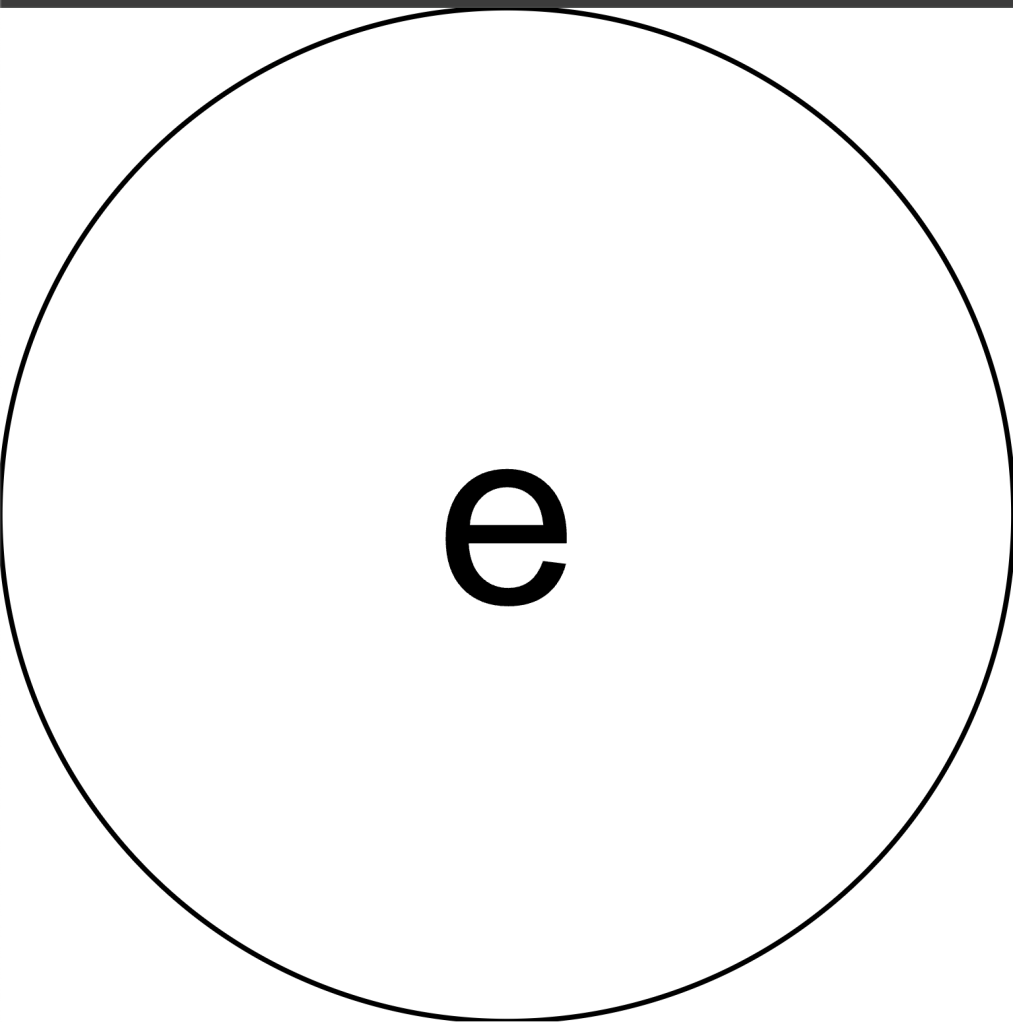
    What we’ll call little e (yes, I’m being cute): this little guy sits at the center of the circle of “you.”

    Picture the inner you — the one that knows you’re skimming the surface, the one that whispers “I’m faking it” or “I don’t quite measure up”. That’s little e. That’s your self-barometer, your anchor, your sense-of-self storehouse.

    When your little e is solid and established, life runs smoother. You hear a story, you filter it through yourself, you respond (or not) from that place. But when little e is shaky, missing, or more “void” than “voice”? Enter chaos as the ultimate distraction.


    What it looks like when little e is missing:

    Imagine standing at the edge of a volcano. Or overlooking a cliff. Terrifying.

    Now imagine that emptiness — the “center” of your existence — is like that: a gaping, empty void. Scary enough, people would rather live outside themselves than face that emptiness. If you don’t have a strong internal “you” (little e, your ego in the healthy sense), you’ll end up living in relation to the outside world instead of from the inside.

    And what happens? Drama. Pure, nonsensical chaos. Because your little e can’t ground you, so you bounce around in the drama. And the “drama” here has no purpose other than to exist for it’s own sake.


    That’s where the classic drama show starts: Karpman Drama Triangle

    Yep — the Victim-Rescuer-Persecutor triangle.

    https://upload.wikimedia.org/wikipedia/commons/9/98/Karpman_Triangle.png

    photo credit:commons.wikimedia Karpman Triangle.png – Wikimedia Commons

    Here’s the quick version:

    • Victim says: “Poor me, woe is my life.”
    • Rescuer says: “Let me fix you, you poor thing.”
    • Persecutor says: “It’s your fault. I told you so.”

    The sick twist: people flip between these roles. Victim becomes Persecutor. Rescuer becomes Victim. It’s all a game of unconscious pay-offs. Meanwhile, nothing meaningful changes.

    (And here’s an advanced idea for those who get stuck in problem-solving: someone who places you in their drama will report a rational problem, “you didn’t do this.” A problem solver will try to solve or explain, but to no avail. Why? Well, because that would satisfy the drama and force someone back to their empty, unsettled self aka little e.)


    Why we keep doing this

    Because when your little e is weak or missing, you can’t face the inside. So you stay in the outside world: the social drama, the stories, the “who’s out to get me,” the hero-rescuer missions. Because those are easier than the void.

    And yes: if you’re always saving someone, or always being saved, or always blaming/being blamed — guess what? You’re probably knee-deep in the drama triangle, either as participant or audience.


    So what to do? (Besides rolling your eyes at people in drama)

    • Notice your pattern. Are you always the Victim? The Rescuer? The Persecutor?
    • Begin to build/strengthen little e: your internal sense of self. Hobbies, interests, commitments that are yours. Not just roles you play for others.
    • When someone else is in the drama loop: don’t become the hero-rescuer by default. Ask: What do you want? What can you do?
    • If you’re exhausted, unhappy, distant — and drama keeps showing up like an unwanted guest: maybe do the work. With someone (see: “good therapist”).

    From where I stand, that was a fascinating thing for the week.

  • To Serve is To Live

    What’s the Point? (No, Seriously. What Is the Point?)

    At some point, we’ve all stood in the shower, stared off into the void (or the shampoo bottle), and asked the big question:
    “What’s the point of all this?”

    Like, really. What’s the point of working? Of meal prepping chicken and rice like we’re training for the Olympics when the only race we’re running is to beat traffic? What’s the point of going to the gym, squeezing into shirts that are a little too tight (okay, maybe that’s just me), and checking credit scores like its the weather?

    Asking “what’s the point?” is not a crisis—it’s actually a solid philosophical question, right up there with “Is cereal a form of soup?” and “Do dogs like me as much as I think they do?”

    But seriously—what happens after you reach the goals?
    You made the money. Lost the weight. Landed the promotion that requires 60 hours a week… which now requires 70 to maintain (and a personal assistant, a neck brace, and maybe a therapist-I know a good one). You bought the car. Paid off the student loans. Traveled to Italy and ate pasta that made those tight shirts even tighter in a different way. You’ve done The Things.

    And then what?

    At 25, I had this little existential meltdown (I think it’s called a quarter-life crisis). I realized I might not become a millionaire—despite my mother assuring me I could be anything I wanted to be, including the world-renowned biochemist I aspired to become after watching Outbreak at age nine. Thanks Dustin Hoffman.

    I mean, sure, buying those new shoes felt good. And yes, the compliments on the designer outfit were nice—until I realized I still felt kind of… empty. Not sad, not broken. Just unsettled.

    Now, some people find meaning in marathons, psychedelics, or finishing every episode of The Office (again). Others chase after this mysterious thing called “existential achievement” like it’s a Pokémon. And for many, the couch and a rerun of Seinfeld is more than enough—and hey, no shame if you’re still riding that DVD life.

    But if you’re one of the curious ones—the ones who can’t shake the “What’s the point?” question no matter how many productivity podcasts or oat milk lattes you consume—then maybe it’s time to stop asking what the point is, and start asking why you’re even here.

    Not to be dramatic, but… why do you exist? What was the reason for you being created in the first place?

    If you ask an atheist, they might say we’re just floating on a rock, existing until we don’t—nothing more, nothing less. Which is philosophically interesting but doesn’t help you get out of bed on a Monday. (No offense, atheists—but seriously, how do you guys do it?)

    Personally, I believe there’s a Creator—a higher Being who loves us into existence—and that gives me meaning. That awful Monday meeting? Purpose. That toddler tantrum in Target? Spiritual growth. That parking ticket? A lesson in patience.

    Because if love is real, and God is love, then you are loved—on purpose. Not randomly, not accidentally. And that changes everything.

    Achievements are fine. Financial freedom is lovely (at least I’ve heard that). But none of it will satisfy the soul. Not fully. Not for long.

    So maybe the real question isn’t “What’s the point?”
    It’s: “What am I here for?”
    And “How can I live the most valuable life with the time I’ve got?”

    If you start there, even the tight shirts start to make a little more sense.

  • Is Fear Making You a Jerk?

    Spend the Ten Bucks, or Spiral Into Existential Dread?

    If someone handed you $10 right now, would you A) gleefully march into a coffee shop and upgrade your sad drip sort of life to a life-affirming double shot, sugar free caramel, heavy cream breve? Or B) stand in the middle of the sidewalk, paralyzed, wondering which of your potential dreams you’ll crush by spending that Hamilton? (Spoiler: It’s just ten bucks. Chill out.)

    This, oddly enough, mirrors a spiritual moment I had during a self-imposed “growth spurt” —the kind where you decide you’re going to get deep, and then immediately regret how deep you went. I can get obsessed sometimes.

    Enter Foxe’s Book of Martyrs. If you’re ever in the mood for a light read that’s actually the opposite of that — like, “ouch-my-soul” level dark — it’s perfect. It’s a collection of stories about early Christians who suffered unimaginable horrors. I used to say unimaginable, but now that I’ve read enough of it to crush any resolve for that week, I wish I couldn’t imagine them anymore. Thanks, John Foxe.

    Much like Christ — who was crucified by the Romans with PhDs in Torture Design — these stories are powerful, brutal, and historically necessary to be aware of. But here’s the thing: constantly marinating in the worst of humanity doesn’t actually help us become better humans. I mean, you don’t get joy by doomscrolling martyrdom, right? Or by seeing others great new thing and telling yourself you’re a loser because you don’t have the same.

    So here’s the twist: whether you’re a CEO, a stay-at-home parent, a single introvert with a dog named Dan, or someone who still doesn’t know how taxes work — life constantly hands us two roads. One leads forward. The other looks like it’s going forward… but turns out to be a really confusing cul-de-sac with a sign that says “Growth Stunted Here.”

    And while we love to say things like, “I just feel stuck,” the truth is, we’re all driving our own little emotional Teslas charged by what we truly desire in life: our mood, our mindset, the narrative we cling to like the cliffhanger of our favorite new show. Nobody’s totally out of control — not even your Aunt Jenny during election season.

    In reality: humans were made in God’s image, with the ability to choose. But instead of staying plugged in to God’s mind-blowing wisdom and presence, we veered off, choosing our own “brilliant” ideas. And surprise! That disconnect kicked off a multi-generational game of Operation: Fear edition. (Don’t step out of bounds, you’ll get buzzed).

    It’s no wonder we fixate on what’s wrong. The world practically dares us to. But being stuck in that pattern doesn’t mean we’re depressed. Sometimes, we’re just being… well, let’s say “chronically cranky.” Or as the street psychologists say: “negative assholes.” It’s a common diagnosis. No copay required. (Send $35 if you’d like though.)

    So the real question is: what are you focusing on today?

    Is it what you fear? What you lack? What you wish were different?

    Or do you believe — even just a little — that you have the power to shift your focus to the good? To be present, even if the present moment involves spilled coffee, a toddler tantrum, or a boss who thinks “urgent” is a personality trait?

    Because choosing to be present — to stop judging, stop spiraling, and just be — that’s the sweet spot. That’s where gratitude lives. That’s where your healthiest self starts waking up and saying, “Hey, this might be okay after all.” After all, life’s a journey, right?

    So, next time you have $10 — or a hard decision, or a tough day — ask yourself: am I spending it on growth, joy, presence… or renting space in Downsville?

    Choose wisely. And maybe still get the best latte of your life. You’ve earned it.

  • Iphone and Emotional Intelligence

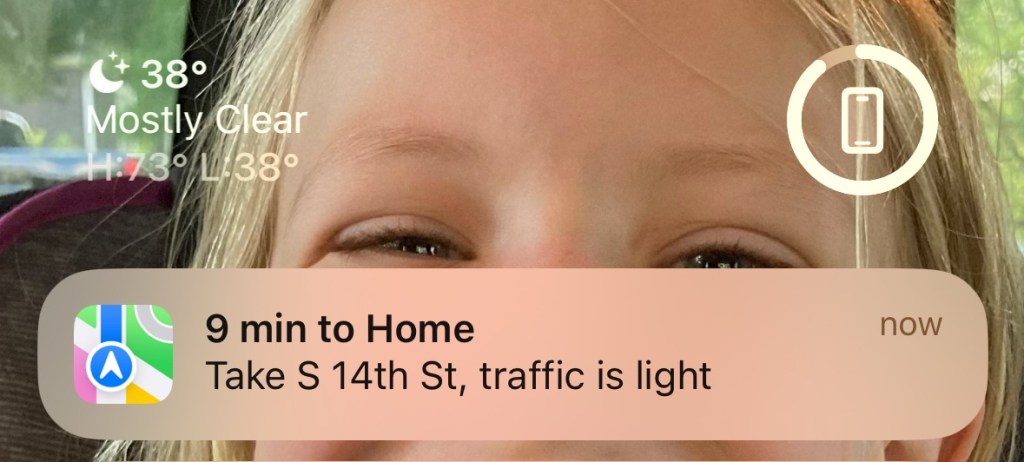
    So, I put my car in drive. Again. I’ve driven to the same destination about five times now. Maybe more. I don’t know—who’s counting?

    Well, My iPhone is.

    I start moving, and then I back up—because I’m just a thrill-seeker like that—and BAM: the familiar little chime goes off.

    “Gym is nine minutes away.”

    Every. Single. Weekday.

    (Ok, not EVERY day? But you get it)

    It’s like my iPhone gaslights me.

    “Im not following your every move, you’re just paranoid.” It knows. It knows when I leave the house. Worse yet, I think it knows I know. (But I also know it knows I know).

    Sundays it whispers, “Church, 13 minutes”, like it’s trying to gently nudge me toward salvation. Other days it nudges me toward capitalism:

    “Office, 11 minutes.”

    And if I’m feeling in need of overpriced snacks:

    “Gas station, four minutes.”

    So what does this say about the iPhone? More importantly, what does this say about me, a supposedly evolved and deeply complex human being with a fully developed prefrontal cortex (let’s hope)?

    It says… my phone learns faster than I do.

    My iPhone doesn’t need a life coach, a therapist, or a hundred repetitions of the same bad idea before it goes, “Hey, this is a pattern.”

    Meanwhile, I’m over here needing a divine intervention and disabling guilt to acknowledge, “Oh, maybe I do this a lot.”

    But here’s the thing: the iPhone doesn’t have feelings. It doesn’t wake up and re-think, “I don’t feel like going to the gym. Maybe today’s a bakery day.”

    Nope. It doesn’t negotiate. Doesn’t justify. Doesn’t self-sabotage.

    It doesn’t wonder if the treadmill is judging it or if the shirt it’s wearing was actually washed (clean and dirty clothes getting awfully close to one another).

    It just sees routine, data, habits. Predicts and then Executes.

    So again, why don’t I learn like an iPhone? Why do I need the same lesson 30, 40, 184 times before it even occurs to me that maybe, just maybe, this is a bad idea?

    Here’s where I stand: good habits are boring, and bad habits are spicy.

    Take doughnuts, for instance. I didn’t need 40 tries to decide I liked doughnuts. That lesson was locked in immediately.

    Ask my mother—she has the smashed-cake baby photos to prove it.

    My daughter? My nephew? One doughnut and they’re in a committed relationship.

    But that same reward system? It works a little too well with gossip. Or swearing. Or skipping leg day.

    Somewhere, somehow, there’s a reward hiding in these less-than-ideal behaviors. A tiny hit of dopamine, a splash of excitement, rebellion even.

    So maybe the real issue isn’t just stopping the bad—it’s finding something good instead.

    Because if “gym” is less rewarding than “bakery,” well then, I can’t exactly trust my feelings, can I?

    My internal compass is calibrated to pleasure, but maybe the compass is a little… off.

    Which brings me to the haunting question:

    How many tiny, subpar decisions am I making every day that are driven by the lower, pleasurable me, versus the ideal gym-goer my iPhone might think I am. (Or at least, think that I think I am).

    Not the huge, dramatic habits—the little ones. The ones that snowball. The ones that come with a side of guilt.

    How many times does it take to change a behavior?

    Thirty?

    Forty?

    Or do I just need to become more like my iPhone?

    Because honestly… my iPhone figured it out in five.

  • Attention Deficit Hyper-something Di…..did you see that one movie?

    Attention Deficit Hyper-something Di…..did you see that one movie?

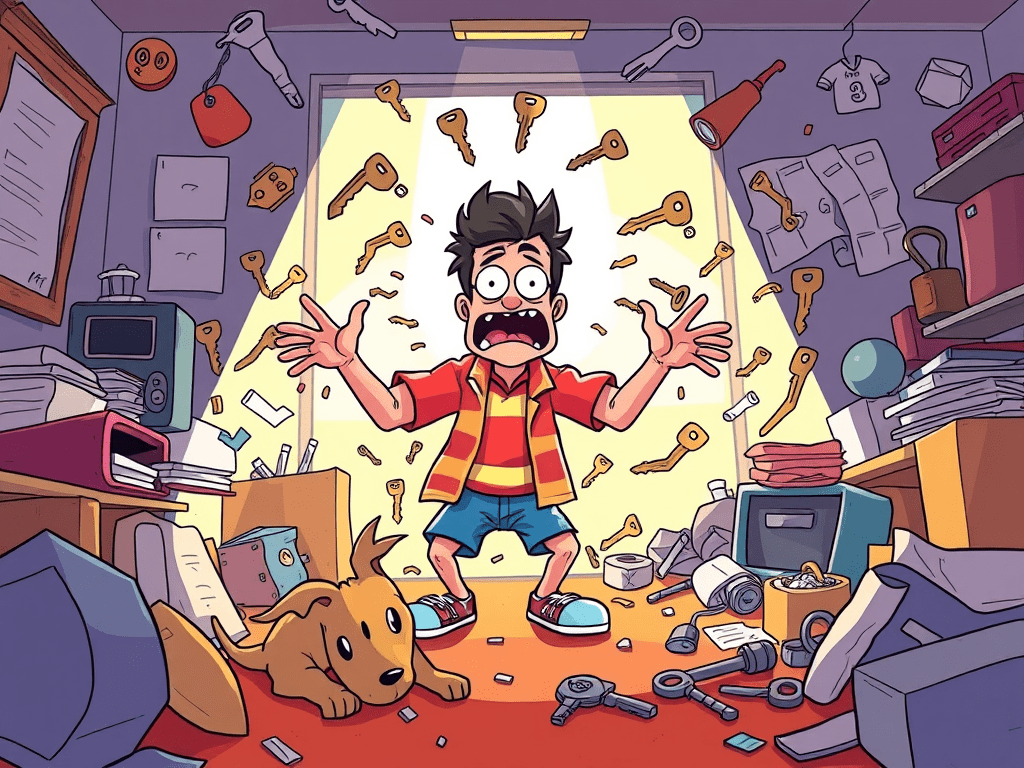
    The Case of the Disappearing Keys

    It was a bright and somewhat sunny Tuesday morning, and I was on a mission: get to work on time and maybe get my kid to school on time too. Sounds simple enough.

    But in the realm of ADHD, that’s a high-stakes game.

    I patted down my pockets, feeling the familiar smoothness of my phone and a strangely pack of gum from the last time I wore the pants. But where are my keys? I could swear I left them right on the kitchen counter. Poof! Like an unintentional magic trick, they had vanished.

    With the precision of a dog looking for his lost bone, I began my investigation. The first suspect: The little backpack I take to the gym. I check, but non he’s innocent. Second culprit: Oh, I must have left them in my gym shorts. Strike Two. OK, for my last and final witness, they must be in my sweater pocket, again from the gym. But wait, I didn’t wear my gym sweatshirt back from the gym.

    Also, should I wash that sweatshirt because I did workout a little in it. I am going to set it on the counter and get to that decision later.

    Time is ticking by…but I am unaware.

    I check my watch.

    Ahhh, 5 minutes have passed and is all I did was look in two places?

    The Odyssey Continues

    After an embarrassing struggle, I found my keys nestled in the middle console of my car. Praise Jesus! Fueled by triumph and adrenaline, I tell my daughter abruptly, “we are going to be late.”

    This one is my fault, but this does not negate the “we” here. After all, WE will be late…the fault? Well, that goes to my mind’s love of chaos.

    I decided to grab my coffee before we leave. So that I can have enough caffeine in my system before the first therapy session, which starts in, well, it already started technically. The ADHD fairy sprinkled her magical ‘let’s-distract-you-with-everything-in-sight’ dust on me.

    I decide the coffee needs some half and half.

    But should I add the fats to the coffee so close to my post-workout routine? Should I just be a man and drink the black coffee?

    Decision making with ADHD is like going into a labyrinth filled with shiny objects. First, I think about my daily caloric intake, specifically from fats. Next, I think about how I don’t drink enough “unaltered” coffee and always need to do something else to it, you know, be “extra,” aka “doing the most.” Also, should I add some sweetener to it? Or is that just another thing I can’t tolerate, the actual taste of coffee?

    I decide that I work hard and deserve the altered coffee drink.

    8:07 AM. The shock hits my body, we are really late.

    “Sweetheart, let’s go! The bell already rang.”

    “OK, I have to go to the bathroom.”

    “What!”

    I can see my future, homeless self holding a sign, “Free Corner Therapy, anything helps.” As I imagine my forgiving client’s patience running thin.

    “How could you take advantage of me, my time is valuable” I imagine them saying.

    “I am going to tell everyone you suck.” They will follow-up with the death blow of therapists everywhere, a bad review.

    The Great Forgetting

    I finally arrived to my first session of an overbooked schedule. Mentally, I am working at being present, not over apologizing and getting right into the material to show that the client’s wait was worth their time.

    “Again, I apologize….” Just like a slow motion Tik Tok video emphasises the behavior that I wanted to avoid. “Fooooooorrrrrrr beeeeeeinnnnnggggg Laaaatttteeeee.”

    Ahhhhhh….noooooooo…….

    Now they have to say, “it’s OK,” that they “get it” that they know the mornings can be, “rough.”

    But it shouldn’t have been rough, if I kept my keys in the same place, didn’t need constant caffeine to stay engaged, as well as some earlier things such as doing one more rep at the gym, doing one more page of writing, pushing for one more preparation of food item and one more conversation with my wife. I can do it….I can fit it in…….

    Conclusion

    Life with ADHD is often a rollercoaster ride where mundane tasks morph into epic adventures. While I may be the proud owner of the world’s most disorganized brain, I wouldn’t change it for anything. Overall, I like the way I think. On the positive end, I can get too focused, and feel emotions deeply. I think this benefits many people. It took me a while to accept the way I think, and clearly there are underlying parts that I want to improve on (cough) fixating on if people like me or not. But, overall, it’s me I have to accept, not try to get people to accept me by enhancing my stress with an ideal “mask.”

    So here’s to the beautifully bizarre world of ADHD! Even if my thoughts sometimes lead me down a rabbit hole or two.

    Now, excuse me while I try to fit in making a smoothie, packing my backpack for the day, and getting across town to the office I work at on Wednesdays.

    Wait, what is today again?

  • This Will Solve Everything!

    This Will Solve Everything!

    Glad you’re here. Glad you decided to do this for yourself. I find that people willing to take the helping hand and in turn, humble themselves, do better in life than those who don’t.

    What is “better?” Well, it’s better than…

    Better than…being prideful, greedy, selfish, masking, denial, prideful.

    Humility in asking for help is better than all the rest of the “successful” traits.

    Humility is simply better than pride and tastes so much sweeter when experienced than does, arrogance or stupidity.

    Yes, to be humble is to be wise. Humility shows you that you can benefit from anyone at anytime, so it’s good to listen.

    What solves your problem then isn’t the solution, but the next problem.

    You want to lose weight, so you starve yourself. Thirty-five pounds later your problem is solved right? You wanted to lose weight right? You should be content now.

    But wait, your life is now more miserable than it was before. Why, well, you now have something to lose, or in this case, gain. You could gain the weight back and be the piece of crap you were before.

    You can’t go back there. You have to keep the weight off, if not lose more.

    You reinforce the belief that only certain versions of yourself are good enough to be admired, the weight-loss part, the thinner legs and slightly flatter stomach. You have to depend on the weight loss to make you happy because it cost you so much.

    But you still aren’t happy.

    So you get fat again and say “I accept me for me.” But now you are the model of yourself you so harshly judged when you were thinner, when you “had it all together.”

    Your willpower was used to get you something you thought you wanted. But you were lied to. Your solution to your identified problem is now your new problem and so on and so forth.

    Humble yourself and allow yourself to see moment to moment what you live for, and be really honest about it.

    You wanted to be sexy, wanted to be wanted, looked at, coveted. Maybe you nobilize that you wanted to feel better, and that might be true. But honestly, what is your problem, other than the fact that you are living for things you think you should live for. You assess yourself based on a measuring stick that was formed from your environment.

    Your pride says you know what to do. Your god-like self says that you alone came up with the solution. Your worst and most destructive parts have led you to a false sense of control that is actually a jail cell.

    I promised you this post would solve your problems. SO here it goes. It’s not the problem your mind tells you is a problem that needs to be solved. You don’t need to lose weight. You don’t need to be better. You need to identify the underlying repetitive narrative that tells you the same thing-feeding you what the problem is. You need to see your brain and body for what they are and stop trying to solve and fix. The resolve here is to sit and wait.

    Yes, patience and quiet.

    You create more problems by doing too much. Life isn’t measured in how much work you do. Life is given to us to be experienced and to do so with a mind focused on the highest things.

    “Whatever you do in word or deed, do it for the Lord, giving thanks through God the Father” Colossians 3:17.

    Serve your highest value in everything and you will discover that your problems are solved because they were never really the problem at all.

  • The Subtle Art of Caring

    The Subtle Art of Caring

    I am fortunate to get to hear stories everyday. Sometimes I wonder how many people wonder if I still care or not?

    I would hope that my presentation is one that demonstrates care, but what if there’s something I am unaware of that comes across as uninterested in the other person?

    But yet, to try to seem like we care isn’t really caring. To actually care requires us to no longer try to depict caring, but to feel what the other person feels.

    But then, how do we find the space for care and compassion for other people around us when we may be struggling ourselves?

    I find that it’s not about our initial thoughts that determine if we care or not, but to care is more about noticing our habitual first thoughts and choosing to act based on what matters the most.

    As humans we are designed to be together in community. I would gamble on the idea that if you dig deep enough, you do care about community. Even if you focus on yourself to be praised by that community. A reason why self-established god status is because you believe it is good for people to praise you, just like you might think it’s good to praise yourself. No god is going to think it’s not good for the people to praise them.

    As a general rule, we desire good for one another. So, although short-sided and misguided, self-promotion can be an attempt to do good.

    But how can we care about people in the right way,?

    1. We were given two ears to hear and one mouth to speak. Yes, all you philosophers out there, people loooooove to get advice, but often listening can show you care so much more.
    2. You can improve your ability to acknowledge the thoughts and then checking the thoughts against what matters to you and then choosing what action aligns with who you want to be.
    3. You want to be good, then do good.

    Good then comes down to thinking if you were that person, what would you want/need in this situation. If you like to talk like I do, then I love it when I get someone to listen to me. I love it when even though the person might not fully get what I am talking about, they can see my passion and because they want me to feel cared for, they care about hearing me talk about my passion.

    These people I like to talk with, nod, acknowledge my ideas, ask questions, even propose an alternative perspective. The best people first try to see what I am saying before they impose their ideas.

    So, thinking about the people I have enjoyed talking to, I work to mimic these people. Because of my own selfish nature, I need models to show me what a listener does to show they care. And no, it’s not being fake to do this, but it’s to live as the person I want to be.

    Now, smiling and nodding along is great, but there is so much more to caring. And this is important:

    Within a healthy relationship, I also like when I am challenged. When questioned with intent to help me see something differently I am grateful for it. I mean, I am initially defensive in my head, but with time and practice I can see how feedback is exactly what I need. So, I also use the relationship and understanding I believe I have with people to share the same challenges or alternative perspective to them. All of this is under the umbrella of caring for people’s good and wellbeing.

    Although the long-term goals of other people may be different than what we want for them, in the short time together we can demonstrate care and compassion by listening. We can improve at removing the expectation that we have to fix or answer everyone.

    Remember, when caring for others, it’s not about you.

    From where I stand, if someone comes to you with a problem, it’s good to listen. After the conversation you might find that the initial “problem” they had wasn’t really the problem. People have a desire to be heard. So, if we do to others as we would like to have done to us, we don’t give advice, correct, or even reprimand (although there is a time and place for all of these things), listen first. Then, through caring and empathetic ears we can ask ourselves what sort of conversations do we like to have and who do we think of when we imagine absolute kindness and caring at it’s best within a conversation.

  • Crushing the spirits of little kids (one bumper car at a time).

    Crushing the spirits of little kids (one bumper car at a time).

    There I was…

    Sitting in a bumper car amid youthful eyes, pigtails, and hopeful expressions. The ride was for all sizes 42” and above. My 77” self barely fit in the cart. Around me were those barely crossing the line from restricted red to admission blue.

    As innocence was radiating from the children behind the wheel, maybe for the first time ever in that position, I looked at them and then their observing parents. One father’s eyes met mine. His protection sensors went up.

    Fathers can feel this sort of thing.

    He looked at me. Looked at the other small children. I looked at his wrist. No wristband. He couldn’t get in. Decided to save some money and not spring for the $50 ticket to ride with his kids. I get that.

    I sprung for it. Now in a moment I had a choice to make. Do I smash full force with my 265 pounds of momentum gaining energy behind every inch of rubber track, jolting the kids into puberty? Or do I settle, drive around and seek out only my own seed to smash from the side?

    The little buzzer went off.

    I glimpsed at the sign “no headfirst bumping.” I thought about this rule for a second.

    I saw a kid, he was headed my way. I evaded him.

    With the 360 degree turn radius I spun around and headed in the opposite direction.

    I was rear ended. I went ahead, saw two girls, sisters I assume. Rolling around laughing at the fact they keep getting stuck. I decide to head in their direction, to lightly bump them loose.

    They turn into me.

    SMASH!

    Headfirst and it looked like I was seeking them out. I quickly spin the wheel, to back out, leave them be in the wake of their trauma.

    I await the screams from an irritated parent.

    I turn around.

    SMASH

    The child looks at me after the recoil of the abrupt stop of his cart. His head pulls up. The brief life he’s lived shows like a movie projected across his eyes.

    I back up again and break free from the multi-cart pileup. Free now to steer clear of anymore lives I don’t want to destroy.

    The gravitas of the situation enhanced by adult eyes, my peers with children younger than mine, make me want to park my cart and throw my hands up.

    SMASH

    This same boy as before, a kid with a mullet peering at me like I’m his elementary school bully. I smile a bit at him and he grits his teeth and drives forward at me again.

    Bump this time, but pushes me into the wall.

    “Ha. Alright, got me.” I say lightly.

    He bumps me again. Then he follows me, chasing me like a sugar-crazed kid who didn’t take his morning medications.

    I glance at the parents…no one seems to be watching him. I pull forward a bit, spinning the wheel to come at him with the little distance I have.

    “You little brat” I think to myself, feeling the surge of energy through my hands and electrifying my left leg to slam down the little red button to charge the car forward.

    “You think it’s funny you little….”

    BUZZ! “Alright riders, please wait till your cart comes to a complete stop before exiting the vehicle.”

    The overhead voice finishes and pan out to see my cart and the boys a few inches from the fronts of the carts meeting.

    I come back to reality. The fog lifts. I am me again, a father, a loving…um at least understanding follower of Christ.

    I….I sort of blanked on my identities and went to this realm of emotions.

    I relied on my body to tell me what to do, rather than what I know to do. I felt annoyed and competitively wanted to smash this annoying bug of a boy into bumper cart oblivion.

    Who was that guy? Where did he come from?

    “I’ve been here the whole time.” My mind says to me.

    Welp, guess I have some work left to do, and that doesn’t mean honing in on my bumper cart skills. But to humble my self that I might not be as good as I think I am.

    To choose the light, you’ve got to know the darkness inside of you.

  • Parasite x Brain.

    Parasite x Brain.

    The parasitic flatworm Dicrocoelium dendriticum aka Liver fluke, aka “zombie ant fungus,” infects the brain of ants resulting in the ant crawling to the tallest point of a plant preparing to get eaten for the highest possibility of fertilization.

    Imagine it.

    The parasite drives the ant up the stem to be crushed in the grinding maxilla and mandible of livestock, ingesting the parasite to flourish in a new home. Then, if it gets too cold, if the ant isn’t consumed, it retreats to try again tomorrow.

    Mindless-drones doing as the parasitic infection demands, with no other objective than to spread. Now, that is scary, good thing we don’t have such a thing in humans.

    Facebook

    Instagram

    Twitter

    TikTok

    CNN

    MSNBC

    FoxNews

    NPR

    CNBC

    Us humans, we like to think we make good choices. We want to be good, we want to do what is best. No one goes forward with full intention of making the wrong choice. Unlike the ignorant ant, humans have intentionality and we loooove to use our smarts to justify our choices.

    Maybe the ants think we are the crazy ones for being influenced by entertainment sources to tell us how to live. The fact that we allow the fictional narrative of social media to alter how we view ourselves might be reason enough for the ants to prefer their colony over a cell phone.

    What if…just what if…the narrative you hold about yourself, the inner assessment of how well you’re doing in life and what you believe is important, was built on false teachings?

    Though we aren’t being manipulated to crawl up any trees, sacrificing ourselves to the further pollination of disease, we are choosing to go to the top of whatever proverbial grass blade, (social outlet) there is and sacrifice our true selves to the influence of misinformation for capital gain or continued social acclimation.

    Ask yourself, why do I do what I do and what really matters to me the most? Take a reflective look at your life and see the truth of where you have invested your time.

    Our entire life is a receipt of where we spent our most precious gift. If you did what you thought you should do, or did something because you wanted to fit in, or did something because you felt some sort of emotional response that you needed to satisfy, then it’s not too late to make a change and start living as yourself and what matters.

    Some brains are too far gone. The infection has spread and lingered for too long and delusion has sunk in. The once-malleable brain now plagued with a barrage of persuasion has the ability to rewrite history to support the slow crawl completely motivated by the influence of the parasitic ideas hellbent on the host’s destruction.

    If life is spent on anything less than the most meaningful thing, it’s a waste.