Tag: humility

  • Care? Or think you SHOULD care?

    So, I was watching the news the other day—like a responsible adult who pretends they’ve got a handle on the world—and in true chaotic fashion, a political clip flashed across the screen. You know the kind: stern faces, firm declarations.

    My brain lights up: “this matters a lot!”

    Is this good?

    Is this bad?

    Is it secretly both?

    Is the media spinning it? Am I being spun? Who really is informed?

    And just like that, I was off—launched into a 25-minute internal monologue that involved four hypothetical scenarios, five imaginary conversations, and me mentally arguing with some “representative” I’m not even sure what they do.

    But let’s skip the 600-word descent into that madness and cut to the punchline:

    I didn’t really care.

    I thought I cared.

    I believed I should care.

    But deep down, beneath the mental gymnastics and obligatory sighs of concern… I didn’t.

    Not really.

    And you know how I knew that? It became extremely boring to try to care. I cared more about caring than the topic I was SUPPOSED to care about.

    Now before you report me to your local “Citizen Who Should Care” hotline, let me clarify.

    I do care. I care about people.

    I just didn’t care about whatever thing was being discussed by angry man in a suit.

    There’s a difference. A big one, actually.

    When you truly care about something, it moves you—it compels you to act, to reflect, to engage.

    When you think you should care, it’s usually because someone else told you it’s important. Or because X did. Or because the anchor on the news got Very Serious™ with his voice.

    So there I sat, mildly stressed, semi-guilty, sipping coffee and wondering why I was so mentally invested in something I had no intention of doing anything about.

    And then it hit me: I was borrowing someone else’s care. Like a care-on-loan program and I have a horrible emotional credit score. The cost of the interest would floor me if I took that on.

    But here’s the strange and glorious twist: admitting I didn’t care, it gave me peace to be that honest.

    Because what I do care about is how people respond to news like that. My heart isn’t in the headlines—it’s with the person who’s afraid because of them, who’s confused, or angry, or overwhelmed.

    Even when I don’t agree with people’s perspective it’s nice to hear their conviction and walk alongside them.

    So instead of funneling all my energy into a political opinion I didn’t even want, I redirected it to empathy.

    And now, the real punchline—maybe the only part you need to hear:

    You only have so much energy every day.

    Which means it’s a precious resource. Like toilet paper during a panic (or eggs these days).

    So ask yourself:

    Do I actually care?

    Or do I just think I should?

    Practicing that tiny bit of honesty can save you hours of mental spiraling (refer back to my loan and interest metaphors, I was proud of that one).

    Because maybe you don’t care about that thing.

    But there is something else you care about a lot. And living in alignment with that thing makes you rational, grounded, and a lot less likely to throw your remote at the news.

    So go ahead—care less, on purpose.

    And care where it matters.

    Thank you for attending my TED Talk slash coffee-fueled ramble.
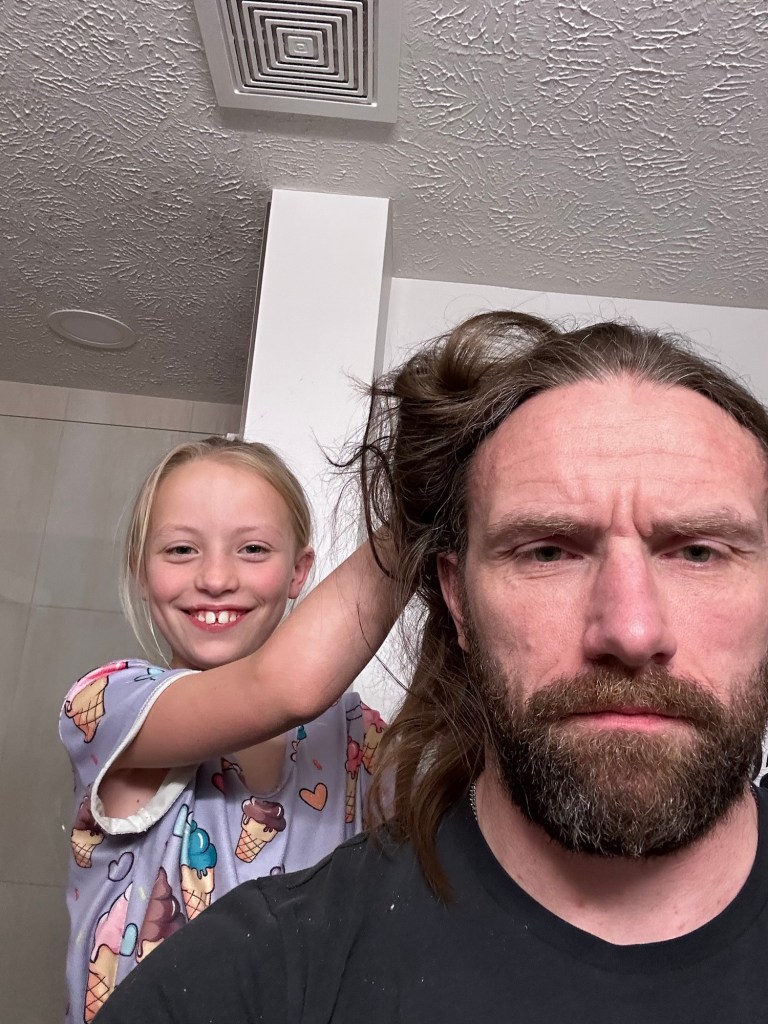
    A pic of me doing anything other than watching the news…..maybe she’ll braid it.
  • What if Darth Vader Was the Hero?

    What if Darth Vader Was the Hero?

    From where I stand, watch the Star War series and image an alternative perspective; what if Darth Vader was actually the good guy and the Jedi were the ones in the wrong?

    Here is my proposal:

    What if, Darth Vader, was actually the good guy in the Star Wars franchise? Let’s take a look at some reasons why I think this is so, and maybe a lesson can be gained out of it. Something about perspective and empathy no doubt.

    Origin Story:

    Before Darth Vader, Anakin Skywalker was a kind-hearted and passionate Jedi Knight who wanted to protect people he loved. His fall to the dark side was due to fear—fear of losing wife and mom. It was his misguided fear, most-likely due to childhood, single mom, responsibilities given to him prior to the emotional maturity. Childhood trauma is not so easily avoided, even in a Galaxy Far Far away. Anakin’s descent into darkness was driven by love and desperation.

    The Jedi Order thought that Anakin was the Chosen One who would bring balance to the Force. This is something he succeeded at he did exactly what the prophecy foretold—just not in the way people expected. The Jedi became rigid in their rules and detached from emotions separated the Jedi from the people they were meant to protect. When Anakin took out the Jedi (though violently) he dismantled a flawed system.

    And lets not forget when Anakin, now Vader destroyed the Emperor.

    Darth Vader took out the Jedi Pharisees and eliminated the power-hungry Sith.

    Was the Empire really that bad?

    Think about the Republic, aka “good guys.” Under their rule, corruption, crime syndicates, and slavery existed unchecked on many planets. The Empire offered order, stability, and unity across the galaxy. In fact, under Emperor Palpatine, technology thrived, interplanetary travel improved, and large-scale conflict was minimal.

    Maybe Vader saw himself as the necessary enforcer of peace. The Rebel Alliance, were freaking rebels who ended up causing widespread destruction. Couldn’t the “rebellion” have learned to negotiate within the confines of the structure. But no, the “good guys” took it upon themselves to overthrow the government and at some point aware of the lives it would cost to do so. Vader was focused on maintaining peace, and did so as Anakin aka Vader always did, through attempts to control with the best information he had at the time.

    Redemption

    True villains don’t seek redemption—but heroes do. In the end, Darth Vader chooses love over power, saving his son at the cost of his own life. This selfless act proves that the good in him was never truly gone. His final moment, where he asks Luke to tell his sister that he was right about him, confirms that Anakin Skywalker was always there, waiting for the chance to do the right thing.

    Ladies and Gentlemen of the Jury:

    Was Vader perfect? No.

    Did he make terrible choices? Absolutely.

    But his journey was one of pain, sacrifice, doing what he believed to be best, and ultimately redemption.

    In the end, he was the one who destroyed the Sith, saved his son, and fulfilled the prophecy. Without Darth Vader, the galaxy would have remained trapped in an endless cycle of corruption and war.

    So was he really a villain?

    After all, how far would you go to fight for what you believe to be right?

    Like Vader, maybe we all have a dark side we need to address.

  • This Will Solve Everything!

    This Will Solve Everything!

    Glad you’re here. Glad you decided to do this for yourself. I find that people willing to take the helping hand and in turn, humble themselves, do better in life than those who don’t.

    What is “better?” Well, it’s better than…

    Better than…being prideful, greedy, selfish, masking, denial, prideful.

    Humility in asking for help is better than all the rest of the “successful” traits.

    Humility is simply better than pride and tastes so much sweeter when experienced than does, arrogance or stupidity.

    Yes, to be humble is to be wise. Humility shows you that you can benefit from anyone at anytime, so it’s good to listen.

    What solves your problem then isn’t the solution, but the next problem.

    You want to lose weight, so you starve yourself. Thirty-five pounds later your problem is solved right? You wanted to lose weight right? You should be content now.

    But wait, your life is now more miserable than it was before. Why, well, you now have something to lose, or in this case, gain. You could gain the weight back and be the piece of crap you were before.

    You can’t go back there. You have to keep the weight off, if not lose more.

    You reinforce the belief that only certain versions of yourself are good enough to be admired, the weight-loss part, the thinner legs and slightly flatter stomach. You have to depend on the weight loss to make you happy because it cost you so much.

    But you still aren’t happy.

    So you get fat again and say “I accept me for me.” But now you are the model of yourself you so harshly judged when you were thinner, when you “had it all together.”

    Your willpower was used to get you something you thought you wanted. But you were lied to. Your solution to your identified problem is now your new problem and so on and so forth.

    Humble yourself and allow yourself to see moment to moment what you live for, and be really honest about it.

    You wanted to be sexy, wanted to be wanted, looked at, coveted. Maybe you nobilize that you wanted to feel better, and that might be true. But honestly, what is your problem, other than the fact that you are living for things you think you should live for. You assess yourself based on a measuring stick that was formed from your environment.

    Your pride says you know what to do. Your god-like self says that you alone came up with the solution. Your worst and most destructive parts have led you to a false sense of control that is actually a jail cell.

    I promised you this post would solve your problems. SO here it goes. It’s not the problem your mind tells you is a problem that needs to be solved. You don’t need to lose weight. You don’t need to be better. You need to identify the underlying repetitive narrative that tells you the same thing-feeding you what the problem is. You need to see your brain and body for what they are and stop trying to solve and fix. The resolve here is to sit and wait.

    Yes, patience and quiet.

    You create more problems by doing too much. Life isn’t measured in how much work you do. Life is given to us to be experienced and to do so with a mind focused on the highest things.

    “Whatever you do in word or deed, do it for the Lord, giving thanks through God the Father” Colossians 3:17.

    Serve your highest value in everything and you will discover that your problems are solved because they were never really the problem at all.

  • This One Time…

    This One Time…

    Humility isn’t found easily. I’m not saying you have to be humiliated to experience it, but it does seem to be found in painful places.

    So, I was thirty years old. I knew it all. This was waaaay after when I was nineteen and knew it all. Long after when I was twelve and really knew it all. No, this was thirty and I had just published my first book after a successful blog run.

    I went by NutritionLuke and I had a blog about nutrition and mental health. Oh, I was also a budding therapist at the time too, so now I really had some weight behind me.

    I stood on a stage with a giant red dot on it and a sign behind me that read, TedX Lincoln. I was giving a Ted Talk about, you guessed it, nutrition and mental health.

    You can view it here if you want.

    I worked for months putting together and memorizing my speech. Also, I suuuck at memorizing things, just ask my Awanas instructors from grades k-8th.

    So, I cut out a lot of material and I put together a speech lasting about eight grueling minutes, most of which was just a story about how I was an overweight kid who ate processed foods.

    I mentioned in my speech about the correlation between processed foods and certain phsycial and mental health conditions and how food may be contributing to the opposite end of the fight, and it was winning.

    According to the materials I had read and the articles I came across, I was cruising along confidently. Then I dropped one line so subtly in the speech “processed foods are leading to increased mental health disorders.” And then I said it, “including ADHD.”

    Dang.

    Yeah, I attributed a neurobiological disorder to what we eat.

    Now, I am not saying certain foods won’t make symptoms of mental health worse, but to claim ADHD was derived from diet alone, well, that was wrong.

    Neurobiology entails that something like ADHD is something developed from brain structure, pathways, chemistry, the sort of thing you are born with. This is why so many people have a family history of ADHD.

    I claimed something and talked about it and I think there are like a thousand views on my my YouTube video and I can’t do anything but tell people that was like ten years ago.

    But that doesn’t matter does it? I was wrong in what I said on stage and have been wrong in what I have said to people in other ways. I have been wrong many times. And so have professionals too. I mean like real professionals (remember COVID?).

    From where I stand, we should all sit with our failures a little more than we should try to dismiss them. We should all be wrong a little more and feel that feeling the moment we realized that we were in fact wrong about something. No one is right ALL the time and when you get your slice of humble pie, eat it up nice and slow.

    Being humble does not come by choice, one does not say how humble they are or claim that they have worked really hard on being humble. That would dismiss the humility in the claim. So, sit with the public shame of your YouTube, Insta-post, TikTok, or dig deep and notice the posts you used to put on FaceBook many, many years ago for some of you. Sitting with these embarrassing things and owning up to them might end up being the best thing that ever happens to you.

    Classic Luke