Tag: empathy

  • To be honest…

    Honestly? I sat down to write this with zero agenda. Nothing. My genius said, “Just start writing and see what happens.” Always a solid strategy.

    So here I am—two lines deep—and already staring at the blinking cursor like it’s judging me.

    Idea one: What happens when the worst thing in life happens?

    Nope. Too heavy. Not today.

    Okay okay, here’s one: What happens…

    Gross. That’s so vague it could be a free online article…oh.

    Wait—I’ve got it:

    I have absolutely no idea. That’s the idea.

    Yep. No one knows the answer. Not me, not you, not that podcast host with the perfect bookshelf background (which I have-less perfect however). Not your favorite fitness influencer, your mom Facebook group, your stylist, or that one guy at the gym who somehow always has advice for everything except leg day (and diet).

    Forgive my little neurodivergent detour here, but when we’re trying to solve problems we usually end up drowning in opinions, frameworks, TED Talks, and cold plunges. Everyone has a hack, and yet… nothing changes.

    So how the heck are we supposed to move forward and live a meaningful life if we don’t even know what “solved” looks like?

    Here’s a thought: maybe we need to zoom out. Like… way out. Maybe we stop looking just at our brains, or our culture, or even our bodies—and take a peek at that deep, mysterious, spiritual part of ourselves.

    Yep. One of those posts.

    Don’t roll your eyes just yet.

    Because every day, you’re solving problems—some big, some small, some that just involve whether or not you can justify buying another pair of kicks/drip. Behind all those decisions is something deeper—something that drives you, that gives your life meaning.

    Dallas Willard—brilliant theologian and philosopher—once said (and I’m paraphrasing here): “What your soul is connected to determines how well your soul is.”

    Translation: If your soul is tied to your job, your team winning the playoffs, your group chat, or your Sunday routine, then your soul is gonna ride the rollercoaster of those highs and lows. But if it’s rooted in something deeper—like, say, the Creator of the whole show—then there’s a steadiness, a sense of “home,” even when things get shaky.

    Yes, even you overzealous people forgetting to turn off the news every once in a while.

    So yeah. No clear answers. No five-step plan. Just a thought worth sitting with.

    And honestly? I think it’s worth it.

  • Size 15: A Journey

    Again…enjoy your sweet, sweet shoes you small-footed people. 😑

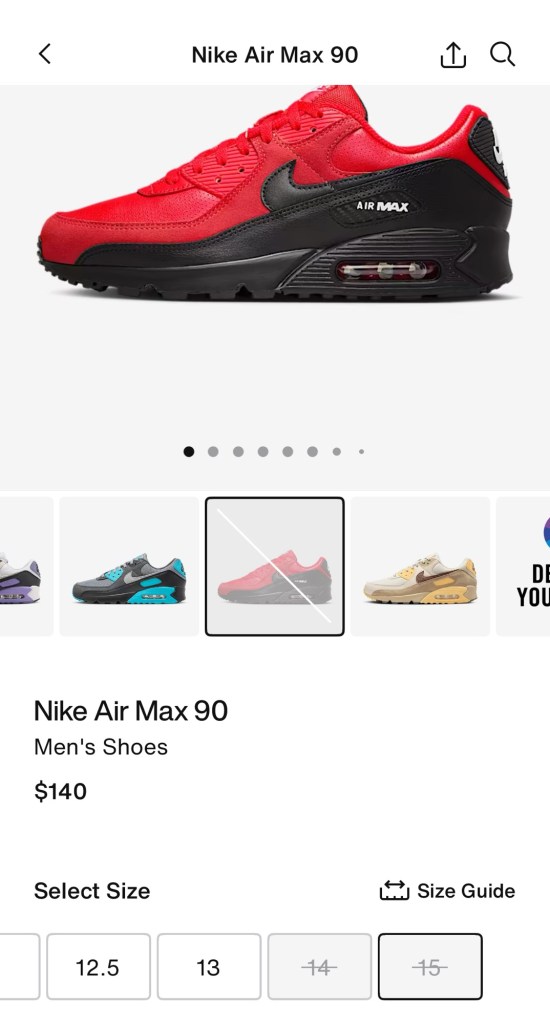
    Let us embark on a peculiar journey—quest, if you will—into the bizarre world of men’s shoes. For this story to be authentic, tis I who is the holder of the size 15.

    Yes, fifteen. A size that sounds less like footwear and more like those small “smart” cars in mid 2000s.

    I invite you, dear reader, to wander—into the labyrinth of online sneaker retailers: Nike, Adidas, New Balance, or whatever new age brand that was forged in the fires of Mount Hype last week. Choose your favorite Jordan, perhaps an Air Max 90 with a color scheme with just the right color palate it screams “you can’t get these!” and here in the sea of exclusivity: size 15? Sold out. Gone. Vanished like your motivation after eating a pack of ultimate stuffed Oreos.

    You might think, “Surely, this foot size would guarantee an overstock!” But no. It turns out that size 15 is a cruel paradox—rare enough to be inconvenient, yet common enough to be competitive. It’s like trying to find a left-handed coffee mug at a right-handed convention. They exist, but there are many people looking for the few that are around.

    Now, you may wonder, “Why on Earth should I care about this man’s odyssey?” Because (enter Forrest Gump accent): life is like a pair of shoes, my friend.

    Let me explain.

    Scarcity breeds value. Exclusivity inflates desirability. That same Jordan in a size 6? Might be on clearance next Tuesday. But a size 15? Full price and sold out in a minute. Maybe even resold for double. People camp out, not for warmth or camaraderie, but to clutch that elusive grail of rubber and laces. And suddenly—bam!—it’s not just a shoe, it’s a statement. A status symbol. A “flex.”

    This, friend, (we are friends now btw) … “Hello friend….Brother (Hulk Hogan voice) anyway…this “exclusivity” is what the sneaker world calls hype. And what we, in the world of hyper-fixation and compulsion might call… a trap.

    Because sometimes, what we want most isn’t actually what we want—it’s just what everyone else seems to want. Context is everything. That prized possession in one mindset? Utter trash in another. Like a prom tux at a Midwest wedding (jeans or cargo shorts only please) or a fork at a hotdog-serving venu—out of place, unnecessary, even ridiculous.

    So what if, just consider here, the thing you’re so obsessed with—the job, the relationship, the approval, the Yeezys—is only precious because of the mental lens you’re wearing right now? And what if, instead of focusing on doing less of the “bad” things, you simply added more of the good stuff—friends, purpose, vulnerability, laughter, a damn shrug the shoulders every once in awhile in the midst of stress 🤷🏻‍♀️🤷‍♀️?

    Maybe then, the cycle breaks on its own. Not through deprivation. But through distraction… by something better.

    Maybe your success isn’t about what “not to do,” but what to do.

    So next time size 15 is sold out, maybe take it as a reminder to think of me, or better the message (yes, the message): you don’t need that shoe. You need a new lens. And maybe take some time off and let little interferences go by saying “wow, look at those trees…just a blowing in the wind. How powerful those branches are to hold up to that.” Though we concluded on trees, we started with feet, my feet, and how through obscurity…we can find something useful, if we look for it.

  • Ye: Loss. Brilliance.Faith.Trauma. and Yes-mental health

    Ye: Loss. Brilliance.Faith.Trauma. and Yes-mental health

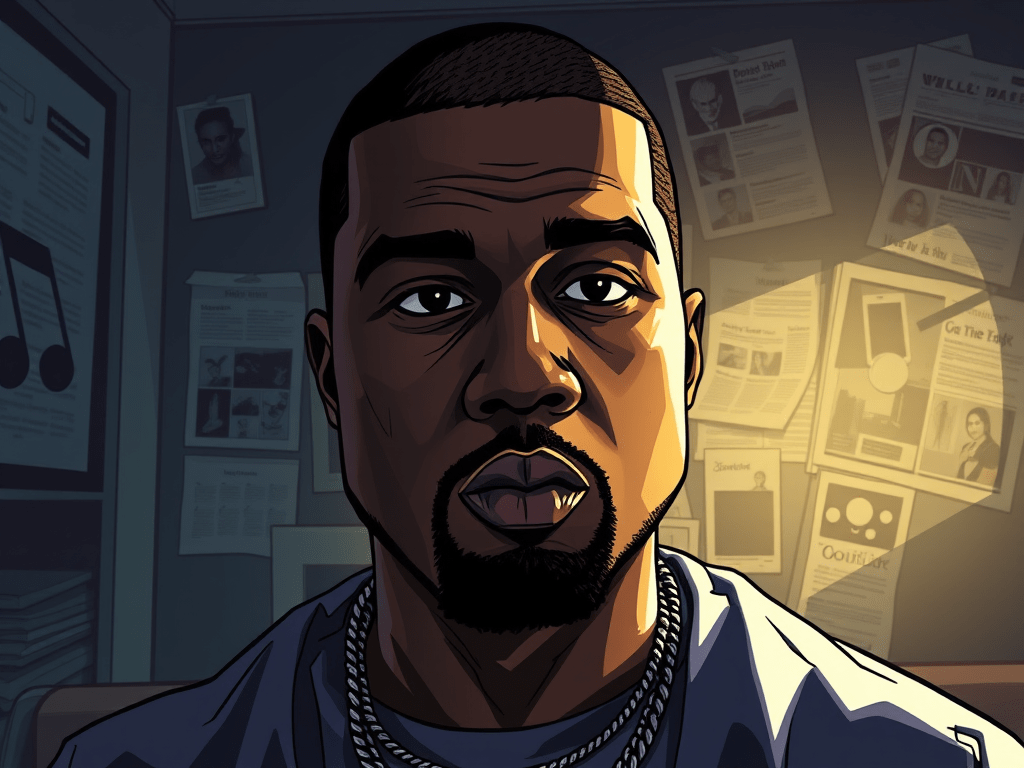
    Genius, crazy, rich, antisemitic, controversial, chaos, egocentric, attention-seeking-These are all words that swirl around the name Kanye West. They’re also words that, if we’re being honest, have swirled around many of our names too, just without the a Kardashian and seven-part documentaries made about us.

    There’s something strangely egotistic in me to even have the urge I felt to even write this. Whether it’s a futile attempt to educate, or just an exercise in reflection, here I am, offering a few words on a person who seems to provoke something in nearly everyone. Ye makes it’s hard to look away.

    It was earlier this week—Monday and on to Tuesday—when news surfaced again about Ye. Or Kanye. Or Yeezy. You can read the article if you want to know the details. Personally I am still digesting the interview where he’s wearing a black White Supremest hood in a hotel room talking for 58 minutes about why he’s wearing the black hood in the first place. But that’s not really the point of this.

    What is the point?

    Maybe it’s this: despite all the controversy, all the confusion, this man keeps creating. Music. Fashion. Art. Controversy.

    And we keep buying it. After all, he didn’t get to be No.4 on the all time Hip Hop sales list by sucking at his craft. We keep listening. Some of us still remember the first time we heard Jesus Walks. For me, it was right after basic training in the summer of 2004. That song wasn’t just music—it was a a light in an otherwise dark era of music. Literally a light too, making one of his first singles be about Jesus, very light-bearing.

    But being good at a craft and rich doesn’t erase trauma. Creativity doesn’t cancel out pain. Nor does fame justify erratic behavior. But what happens when you start connecting the dots?

    What happens when we hear that childhood trauma shaped much of this man’s life—long before he had a platform to express it?

    What does that do to a boy, growing up and figuring out what it means to be a man?

    Kanye shared that he found magazines in his mom’s closet—magazines that shaped his understanding of sex, identity, and self-worth in ways that were far beyond his years. And long before the headlines, there was that little boy trying to make sense of what he saw, of all that he experienced.

    We all have experiences that shaped us, for better or worse. And here’s the kicker, we didn’t get to chose those experiences or decide how they affect us.

    So when we rush to label, to cancel, to condemn—what are we really doing? Are we holding someone accountable? Or are we just distancing ourselves from the parts of him that remind us of the parts we try to hide in ourselves?

    After all, isn’t pornography the bane of a young man’s existence these days? Are the adults now, failing to admit to themselves their own shaping of sex, relationships, what it means to be a man?

    Empathy is the bridge to forgiveness.
    Not because forgiveness means agreement. But because empathy allows us to see someone as someone—not as a headline, not as a cautionary tale, but as a human being formed by the sum total of his experiences.

    If you zoom in on Kanye West, you can isolate any number of choices, some of which are difficult to defend. But if someone zoomed in on your worst moment—your ugliest thought—what would they find?

    This isn’t a defense of bad behavior. It’s a reflection on how quick we are to misjudge when we don’t know the whole story.

    In C.S. Lewis’s The Great Divorce there is a man Len, a spirit who was a murderer in life, but now reconciled with God and is in Heaven. Another man, the Big Ghost believes he is a “good man” despite evidence that he was not. the Big Ghost character would be that of a man today, maybe you who demand’s recognition for being good, for doing right. Meanwhile that man, the character Big Ghost fails to repent and rejects heaven in the process. Yes, the murder remained in Heaven.

    Christ flipped the typical human narrative of what appears to be good may not be, and what appears to be distant or far from God may be the closest. Like Mr. West who has many faults, we too can choose to be the Big Ghost and cling to our own “goodness” and fail to relate to someone who is easy to categorize as a “bad” one.

    No person is defined by a single act—good or bad. If we believe otherwise, then we’re condemning ourselves every time we fail. We’re erasing nuance, context, and the messy truth that people are often doing the best they can with what they’ve got.

    To live with grace is to recognize that. It’s to understand that every decision is filtered through a complex web of history, beliefs, trauma, and identity. It’s not about excusing—but about seeing.

    And maybe that’s what Kanye, in all his chaotic truth, mirrors back to us. Maybe that’s why his story unnerves us. Because in his rawness, we’re forced to look at our own contradictions. Our own judgments. Our own worst parts. And if we’re honest, maybe they’re not as far from his as we’d like to believe.

    So the next time you’re tempted to judge—pause. Ask yourself this-is this about what they did, or what it stirred in me? Is this really about them—or is it about my own discomfort?

    Because the truth is, we all carry things that others wouldn’t understand. And we all hope—deep down—for grace when we least deserve it.

  • Care? Or think you SHOULD care?

    So, I was watching the news the other day—like a responsible adult who pretends they’ve got a handle on the world—and in true chaotic fashion, a political clip flashed across the screen. You know the kind: stern faces, firm declarations.

    My brain lights up: “this matters a lot!”

    Is this good?

    Is this bad?

    Is it secretly both?

    Is the media spinning it? Am I being spun? Who really is informed?

    And just like that, I was off—launched into a 25-minute internal monologue that involved four hypothetical scenarios, five imaginary conversations, and me mentally arguing with some “representative” I’m not even sure what they do.

    But let’s skip the 600-word descent into that madness and cut to the punchline:

    I didn’t really care.

    I thought I cared.

    I believed I should care.

    But deep down, beneath the mental gymnastics and obligatory sighs of concern… I didn’t.

    Not really.

    And you know how I knew that? It became extremely boring to try to care. I cared more about caring than the topic I was SUPPOSED to care about.

    Now before you report me to your local “Citizen Who Should Care” hotline, let me clarify.

    I do care. I care about people.

    I just didn’t care about whatever thing was being discussed by angry man in a suit.

    There’s a difference. A big one, actually.

    When you truly care about something, it moves you—it compels you to act, to reflect, to engage.

    When you think you should care, it’s usually because someone else told you it’s important. Or because X did. Or because the anchor on the news got Very Serious™ with his voice.

    So there I sat, mildly stressed, semi-guilty, sipping coffee and wondering why I was so mentally invested in something I had no intention of doing anything about.

    And then it hit me: I was borrowing someone else’s care. Like a care-on-loan program and I have a horrible emotional credit score. The cost of the interest would floor me if I took that on.

    But here’s the strange and glorious twist: admitting I didn’t care, it gave me peace to be that honest.

    Because what I do care about is how people respond to news like that. My heart isn’t in the headlines—it’s with the person who’s afraid because of them, who’s confused, or angry, or overwhelmed.

    Even when I don’t agree with people’s perspective it’s nice to hear their conviction and walk alongside them.

    So instead of funneling all my energy into a political opinion I didn’t even want, I redirected it to empathy.

    And now, the real punchline—maybe the only part you need to hear:

    You only have so much energy every day.

    Which means it’s a precious resource. Like toilet paper during a panic (or eggs these days).

    So ask yourself:

    Do I actually care?

    Or do I just think I should?

    Practicing that tiny bit of honesty can save you hours of mental spiraling (refer back to my loan and interest metaphors, I was proud of that one).

    Because maybe you don’t care about that thing.

    But there is something else you care about a lot. And living in alignment with that thing makes you rational, grounded, and a lot less likely to throw your remote at the news.

    So go ahead—care less, on purpose.

    And care where it matters.

    Thank you for attending my TED Talk slash coffee-fueled ramble.

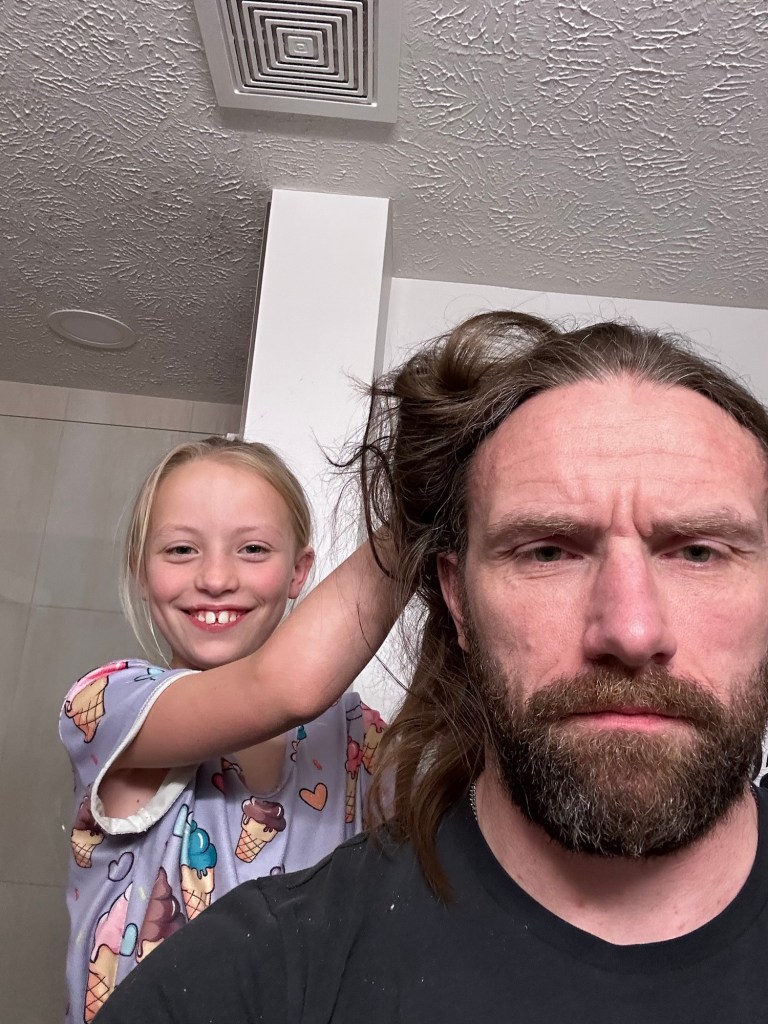
    A pic of me doing anything other than watching the news…..maybe she’ll braid it.
  • Personality Hires

    Personality Hires

    To some extent, people are who they are and to expect them to be someone else, or naturally change into this other “ideal” person isn’t just a waste of hope, but it may lead to crushing feelings of failure for the one whom you want to change.

    There we have it, accept people for who they are and stop trying to change them, right?

    You tell me. When was the last time you had a friend, relative, spouse, roomate, church member, klansman even that you gave feedback to and they took it and ran with it?

    You may expect the feedback to be taken like this:

    “Oh thank you…I never knew I was a jerk. In my forty years of life, I assumed it was everyone else’s problem. Now I know better and will be more approachable.”

    Sure, some of the good ones will notice of small asks such as “take out the garbage,” or “Get those reports done on time.” But more advanced techniques such as “being more empathetic” or “I want my spouse to WANT to do these things” may require a bit more understanding of the person you are talking to. And I know we all love the idea that all people are capable of the same possabilites, but we aren’t all meant to do all things.

    One of the worst things that can happen when meeting with people for a problem they are having is trying to convince them to change who they are.

    For example, I was recently on a daddy-daughter trip through the Mall of America, one of the biggest malls in the world. Stacked sky high full of shopping, amusement park rides, foods, toys, all the items a child dreams of. However, I noticed a few things.

    1. My daughter doesn’t like to be told what to do or even offered options more than the ones she has already considered- she told me this.
    2. I shouldn’t expect anything. From moment to moment, she likes one thing, but then likes another.- She even asked to eat sushi which I never thought would happen.
    3. When she asks for something and I tell her “no” (rare, but it does happen), she doesn’t respond to it. But more than that, she keeps asking. Not in an annoying way or just to manipulate, but because she gets fixated on it, like can’t stop thinking about it. Much like the stuffy we saw on day one was talked about for the next two days! “When are we going to get that stuffy?” The thought would hit her in the middle of swimming, or while at dinner. Just a loop, playing around and around.
    4. If you are not concrete with her, she will find the loophole. Even if you lay out the plan, she is a wordsmith with her ability to redefine the terms of what was said.- “you said “no” earlier, but does that still apply now? And were you meaning no forever or just today?”
    5. She loves talking to adults that respond back to her with useful information. She finds the typical questions of “hows school” odd and doesn’t care to think of an answer. “Good” she says to keep people off her back. But if interested you get her to tell you anything.
    6. She is….well, much like her mom and dad in so many ways that I am hit with reality over and over again how much I need to listen and not get ahead of myself or assume the worst.

    You see, we all have brains that are wired from genetics, through birth and raised in environments that later attend to certain things and not others. We all pick up different details and hold things in our minds in different ways. We were all made uniquely by God for a reason and therefore “limits” as people like to argue, against, aren’t condemning, but freeing to find what we have no business in and then can let go of.

    One theory on human development is that humans learn by association or better, relationships to something else. To understand a concept, or thing, you have to have something earlier experienced to help conceive the idea.

    For example, numbers. Numbers are nothing to a baby. But as the child learns the material world and its significance, she may realize that two of something is more than one. Eventually numbers represent meaning but then the meaning is later exchangeable. Thus, two chores are not greater than one chore…unless you like chores of course.

    My daughter, much like your employee, or aunt, uncle, mother, garbage man, pilot, coroner, they hold things, see things, interpret things in their own way. I am not a better parent to anyones kid because I am formed into being my child’s parent. But it has taken me a long time to better understand her as her own person to live this role as an earthly father for her to influence who she is going to be.

    How many times do we stop seeing people for who they really are, only to see them for how we hold them in our heads, no matter how faulty that is. We stop listening to our friends and family because we “know what they are going to say.” Or we stop looking at our wives, employees, coworkers because we fail to see them as people.

    Side note: Do you ever watch those movies with evil henchmen who just die in masses by the hero? I mean, those people were humans, with moms and dads, lives, hobbies, all of their details were just as important to them as yours are to you. And here we are, watching John Wick go through and lay them down by the dozens. Just saying, I wonder how those families are doing after our “hero” obliterates their loved ones.

    Think of the employee who doesn’t do quality work because they realize they can skip the hard parts and probably won’t get caught. For this person, experience has taught them that there is little value in the work itself and the end product is what is most important. If you place this employee on a performance improvement plan, it can temporarily reinforce the fact they are being watched, but that’s about it. We hope it will instill the work as a priority, but wouldn’t we also hope they knew that already, that as adults they have worked before and that whoever is paying you, we can safely assume, wants quality work?

    Old habits, or core personality traits, and core beliefs about what it means to work and value one has in work, not to mention inner feelings towards community or principle, integrity, deeper elements of quality work, their spiritual relationships, all determine what a person will do in work, long-term.

    Not to sound too much like a tyrant on a Disney movie who says this person can’t do this, or can’t do that, the truth is, some people can’t do what is required to stay the partner or employee needed in the relationship. Not that one isn’t good for anyone or any job, but that this current situation, with their personality, won’t work out.

    Admitting limits isn’t a bad thing, but a peaceful acceptance that you are made for some things and not for others. You aren’t made for everything and sometimes a job will serve mercy and let you go so you don’t have to keep trying to be someone you aren’t. The key from any situation is to accept it for what it is and use the opportunity to figure out what your strengths are and where you can best leverage these strengths.

    Maturity, new information, new situations, encouragement or discouragement, all things can change a person’s perspective, but the change will still be from the person doing it, and will only change if the person sees some value in the change. You can’t make someone care about something, you can only show them and let them decide to care or not.

    So, what’s wrong with a personality hire? As someone who is personable, I find it helpful to work with people who fit more so than someone who might have a better resume, but isn’t willing to change or learn to the human beings around them.

    What’s worse than a jerk who is intentionally mean? Someone who is a jerk, doesn’t know it, doesn’t accept feedback about it, and justifies their mood and approach based on the wrong that has been done to them.

    If you are looking for an employee or partner, from where I stand, I think it is the most critical to find someone who is willing to take feedback and respect boundaries of others and work demands. Otherwise, you’ll be fighting an uphill battle to someone who is the way they are and will be whether or not they get on a performance plan, an ultimatum, or simply just get ignored by people that don’t want to be around them.

    In summary, sometimes your problems in life are you, not them. Take the feedback, meditate on it, ask yourself what matters to you and stop trying to cover inadequacies, but own them as equal parts of yourself.
  • We all have a little Trump inside of us.

    We all have a little Trump inside of us.

    If I were you and you were me, what would you see?

    What would you experience if you were me writing this?

    You can’t possibly know what I am going through. You can’t because I am me. I have lived as me my entire life. Being me entails having my personality, my perspective, my experiences and how people experience me and me them.

    So, how can you possibly walk in my shoes if my entire life experience led me to seeing things the way I do and producing the reactions I have.

    You can’t “get” someone. You can relate to them from your own life experience, but “getting it,” shouldn’t be the goal.

    Here’s my sales pitch for peace:

    Empathy is the bridge to forgiveness.

    To be empathetic is the willingness to see the other person’s perspective. When you are hurt, scared, angry, sad, escalated in some way, the choice to empathize and relate to people seems impossible.

    Why would we choose to distance or judge someone? Judgment, justice, disgust, fear, anger, all of the above.

    I guess the real question is, why should we empathize with people who we deem to be “bad” or “wrong?”

    For your own peace.

    Empathy and forgiveness leads to a peace for the one who practices it. If you want peace, in your relationships, at work, watching the news, dealing with difficult customers, then you need to allow yourself to relate to the person you are dealing with.

    Typical argument against empathy:

    “But what if the person is a sociopath and doesn’t care about people, why should I relate to them?”

    Answer: One of the criteria for anti-social personality disorder aka sociopath is lack of empathy. So, if you choose to categorize people into a box that is “unrelatable,” then you just did what they do.

    If you want to be right, enact justice, judge and distance from someone, remember they are people too.

    The way humans are designed-they have parents, and those parents had parents, and so on. All the ancestry that came before us led to the “us” here today and leading to the “them” that is standing before you now. Both nature and nurture play into who we are today and why we chose what we chose. Not to mention, the choices available to as at the location and time in history we were born.

    Judge if you dare

    So, if you want to judge and enact judgment on people because of your god-like view of what should be, remember: people only know what they know and don’t know what they don’t. People learn by way of association and do what they do based on what was experienced, internalized, and believed to be true.

    People do the best they can with what they’ve got. People don’t do your best or a general best, but their own best. Even one who murders, chose to do so based on what they thought was the best choice. There isn’t a person who has walked this earth who hasn’t done the best they could with what they’ve got. Also, with the exception of Jesus, there isn’t a person who hasn’t done something they later revisit and think things could have been done differently today.

    If you can allow yourself to see that you’ve once misjudged, acted out of anger, chose based on limited information, then you can understand that someone else may be doing the same thing. Sure, they may have chosen differently than you would have, but their available choices, their normalized decisions, observed behaviors from family and friends, and many many other factors in their experience have led to them choosing to act as they did.

    You get angry and you yell.

    Someone else gets angry and they drink.

    Another person gets angry and fights.

    All are angry and neither can judge the other from their limited perspective.

    Finding yourself relating to others, and allowing yourself to be in their shoes, is much more than, “getting it.” Empathy will provide the ideal life of peace you want. If you want the peace that is.

    If you want to judge, then so be it, but you’re doing exactly what they are doing. The exact same thing you are judging is the same thing you can’t forgive or accept about yourself.