So, I put my car in drive. Again. I’ve driven to the same destination about five times now. Maybe more. I don’t know—who’s counting?
Well, My iPhone is.
I start moving, and then I back up—because I’m just a thrill-seeker like that—and BAM: the familiar little chime goes off.
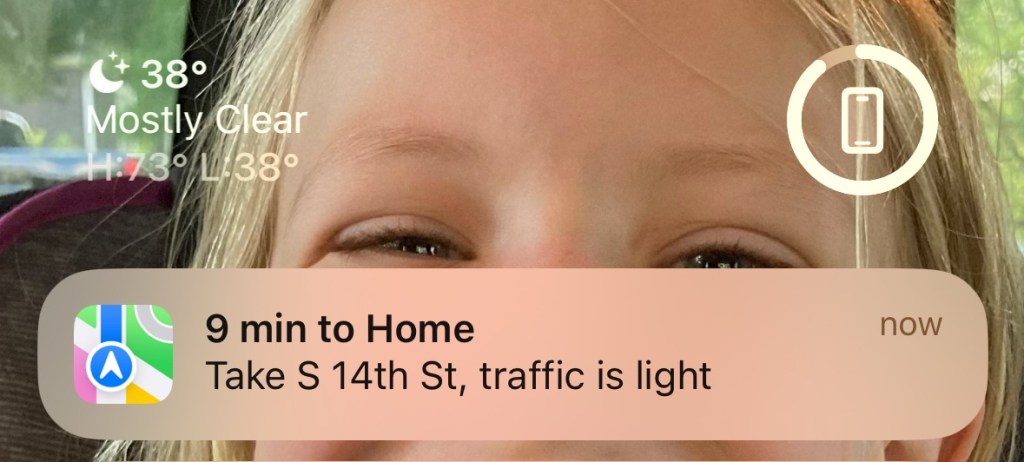
“Gym is nine minutes away.”
Every. Single. Weekday.
(Ok, not EVERY day? But you get it)
It’s like my iPhone gaslights me.
“Im not following your every move, you’re just paranoid.” It knows. It knows when I leave the house. Worse yet, I think it knows I know. (But I also know it knows I know).
Sundays it whispers, “Church, 13 minutes”, like it’s trying to gently nudge me toward salvation. Other days it nudges me toward capitalism:
“Office, 11 minutes.”
And if I’m feeling in need of overpriced snacks:
“Gas station, four minutes.”
So what does this say about the iPhone? More importantly, what does this say about me, a supposedly evolved and deeply complex human being with a fully developed prefrontal cortex (let’s hope)?
It says… my phone learns faster than I do.
My iPhone doesn’t need a life coach, a therapist, or a hundred repetitions of the same bad idea before it goes, “Hey, this is a pattern.”
Meanwhile, I’m over here needing a divine intervention and disabling guilt to acknowledge, “Oh, maybe I do this a lot.”
But here’s the thing: the iPhone doesn’t have feelings. It doesn’t wake up and re-think, “I don’t feel like going to the gym. Maybe today’s a bakery day.”
Nope. It doesn’t negotiate. Doesn’t justify. Doesn’t self-sabotage.
It doesn’t wonder if the treadmill is judging it or if the shirt it’s wearing was actually washed (clean and dirty clothes getting awfully close to one another).
It just sees routine, data, habits. Predicts and then Executes.
So again, why don’t I learn like an iPhone? Why do I need the same lesson 30, 40, 184 times before it even occurs to me that maybe, just maybe, this is a bad idea?
Here’s where I stand: good habits are boring, and bad habits are spicy.
Take doughnuts, for instance. I didn’t need 40 tries to decide I liked doughnuts. That lesson was locked in immediately.
Ask my mother—she has the smashed-cake baby photos to prove it.
My daughter? My nephew? One doughnut and they’re in a committed relationship.
But that same reward system? It works a little too well with gossip. Or swearing. Or skipping leg day.
Somewhere, somehow, there’s a reward hiding in these less-than-ideal behaviors. A tiny hit of dopamine, a splash of excitement, rebellion even.
So maybe the real issue isn’t just stopping the bad—it’s finding something good instead.
Because if “gym” is less rewarding than “bakery,” well then, I can’t exactly trust my feelings, can I?
My internal compass is calibrated to pleasure, but maybe the compass is a little… off.
Which brings me to the haunting question:
How many tiny, subpar decisions am I making every day that are driven by the lower, pleasurable me, versus the ideal gym-goer my iPhone might think I am. (Or at least, think that I think I am).
Not the huge, dramatic habits—the little ones. The ones that snowball. The ones that come with a side of guilt.
How many times does it take to change a behavior?
Thirty?
Forty?
Or do I just need to become more like my iPhone?
Because honestly… my iPhone figured it out in five.

 From Where I Stand